Buying a Used Pool Cue: What to Check Before You Pay
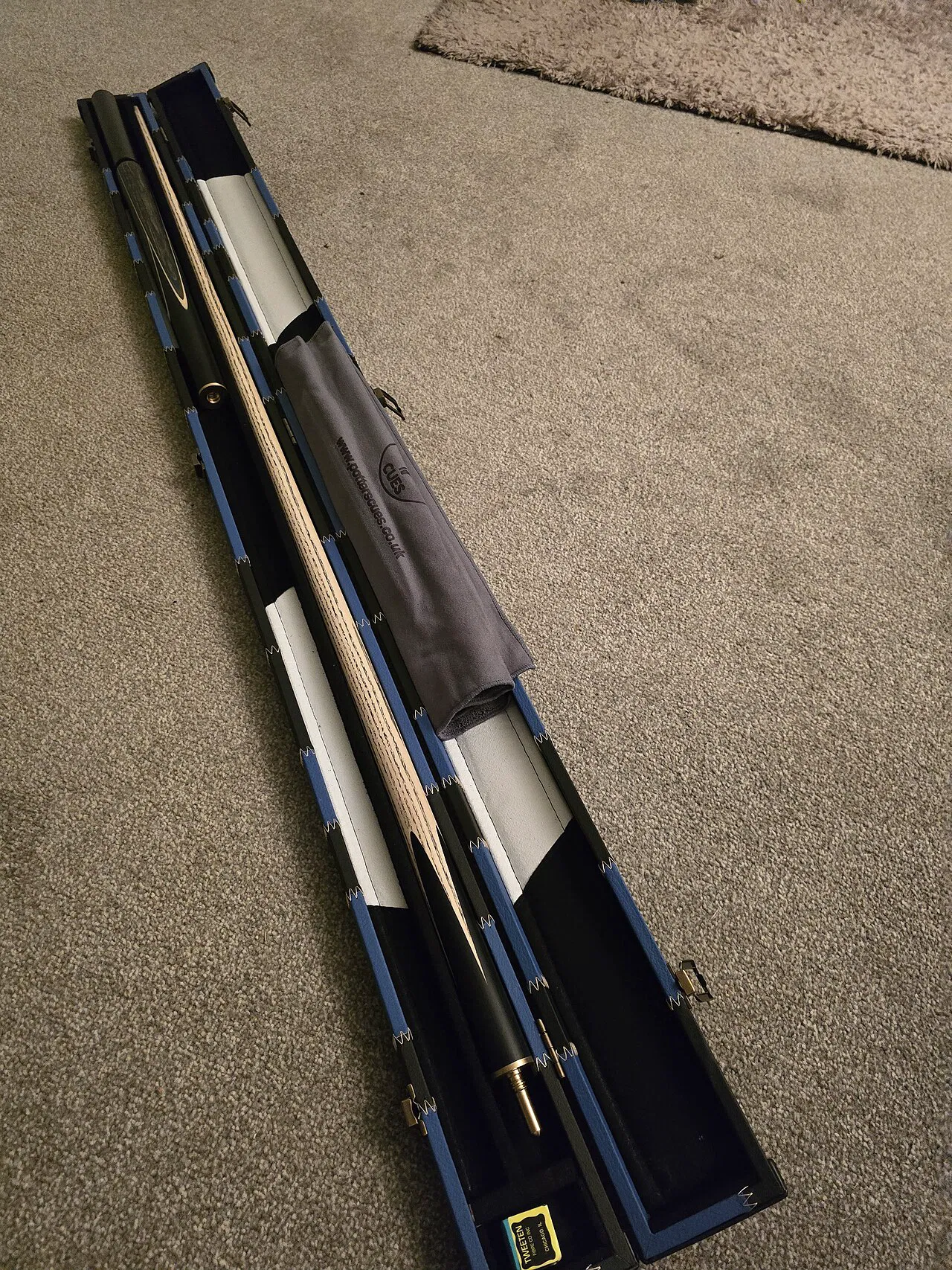
A used cue is often the better buy at a given price — same build as new, minus the showroom premium. The catch is that every expensive problem a used cue can have is invisible in listing photos: a bent shaft, a stripped joint, a ferrule with a hairline crack, wood sanded past its minimum. Sellers rarely mention them. A ten-minute inspection catches nearly all of it — and two facts most listings leave out do the rest: warranties do not follow the cue to a second owner, and a worn tip is cheap to fix while a warped shaft is not.
The Ten-Minute Inspection
Do these in order — if the cue fails step one, you can usually stop there.
- Sight the shaft. Hold it butt-end at your eye and look down the length toward a straight edge; rotate slowly through a full turn. A bend shows as the tip drifting off the line. Sighting beats rolling — our warp check guide covers why table rolls produce false wobble, and Dr. Dave notes a roll more often exposes a joint defect than a bent shaft.
- Roll the pieces anyway — shaft alone, butt alone, then assembled. If each piece rolls clean but the joined cue wobbles, suspect the joint, not the wood.
- Check the joint. Watch the pin from the side as you turn the butt — it should not orbit. Threads should be crisp, and the cue should screw together smoothly and close with no gap between the faces. Then twist the shaft gently once seated: any play means joint wear, and sloppy joints are effectively permanent (JFlowers' used-cue advice puts it plainly — a loose joint undermines every shot). Our joint types guide identifies what you are looking at.
- Check the ferrule and tip. Hairline cracks along the ferrule, a ferrule lifted off the wood, a tip mushroomed over the edge or glazed hard and shiny — the first two are repair bills, the second two are routine wear. When to replace a tip lists the end-of-life signs; our ferrule explainer covers what the part does.
- Measure the shaft. A cheap caliper near the tip gives the real diameter — compare it with the seller's claim and with the maker's minimum. Every past cleaning with sandpaper took wood off permanently, and manufacturers publish floors below which the shaft is considered altered: Predator lists 12.25 mm for the 314-2/314-3, 11.40 mm for the Z-2/Z-3 and 12.50 mm for the Vantage; REVO shafts must never be altered from their 11.8, 12.4 or 12.9 mm as-built sizes; McDermott's floor is 11.75 mm (figures compiled by LeaguePool from the makers' own terms). An under-size shaft has been sanded — walk.
- Look over the butt. Run a hand along the wrap for loose or slick spots, read the finish in raking light for dents and patched areas, check the butt cap and bumper.
- Hit balls if you can. A cue that rattles or buzzes on a firm stroke has a loose part you will hear before you see.
What Each Problem Costs to Fix
The inspection only matters if it moves the price. These ranges come from US shop price lists compiled by LeaguePool:
| What you find | Fix | Typical shop price | Deal or walk? |
|---|---|---|---|
| Worn, flat or glazed tip | Retip | $15–30 standard, $30–65 layered | Deal — expect it on most used cues |
| Dirty, sticky shaft | Clean and burnish | $5–20, or DIY | Deal |
| Small shaft dents | Steam / recondition | $20–30 | Deal |
| Cracked ferrule | New ferrule + tip | $40–50 plus the tip | Deal if the price drops to match |
| Joint clicks or won't seat flat | Reface joint | $10–20 | Deal, if the pin itself is straight |
| Slick or loose linen wrap | Repress or rewrap | $25–35 repress, $40–100 rewrap | Deal — see wrap types for material costs |
| Bent pin or stripped threads | Pin / insert work | Few shops publish it | Walk unless the cue is special |
| Warped shaft, or sanded under minimum | Replace the shaft | $145–225 for maple | Walk — or price it as a butt only |
The pattern: cosmetic wear (tip, dirty shaft, tired wrap) is the ideal used buy — it looks bad in photos and costs little. Structural problems (warp, sanded-thin wood, bent pin) are the walk-aways, because shops will not straighten a warped shaft with any guarantee.
The Warranty That Does Not Transfer
This is the biggest real difference between new and used, and it is in the makers' own terms: Predator warrants cues and shafts to the original purchaser only, non-transferable, with proof of purchase from an authorized dealer. McDermott's lifetime warranty likewise belongs to the original purchaser with the receipt — and its warpage coverage only began in 2004, so older McDermotts never had it. Viking's lifetime warranty requires registration within 60 days by the original owner and does not transfer — the same terms our Valhalla guide found in the fine print. Meucci offers a one-year limited warranty.
So a listing that says "lifetime warranty" is describing something you almost certainly cannot claim. The upside is symmetric: the used discount is what pays you for taking that risk.
What a Used Cue Is Actually Worth
There is no blue book for cues. The method that works, per LeaguePool's guide:
- Identify the exact model and shaft — model name, serial number, or send photos to the maker; McDermott and Meucci will both help identify their cues.
- Look up sold prices, not asking prices — eBay's sold-listings filter or completed forum sales; three or more real sales give you a number.
- Compare with today's new price for the same model, or a comparable current cue if it is discontinued.
- Subtract the repairs from the table above — a cue needing a ferrule and tip is worth roughly $55–80 less than a clean one.
Cue-value threads on AzBilliards fill in the market reality: the oft-quoted "half of retail" starting point gets disputed in every thread — still-in-production production cues often go for less because a buyer can order new in two clicks — while only high-end and custom work reliably holds value. Two hard rules from the same guide: a cue that cost under $100 new has almost no resale value (a cracked ferrule can cost half the cue's price to fix — new-with-warranty is usually smarter at that level), and vintage or custom cues trade on collector rules — provenance, serials and letters of authenticity, not play specs.
Where to Buy, and What Each Channel Risks
| Channel | Prices | Risk | Best for |
|---|---|---|---|
| Local billiards or repair shop | Higher | Lowest — inspected, often fixed, you can hit balls | A first used cue |
| Pool hall and league sellers | Fair | Low — try it first, seller has a local name | Production cues and shafts |
| Online cue dealers | Market rate | Low–moderate | Vintage and custom |
| Forum for-sale sections | Fair | Moderate — post histories are visible | Shafts and players' cues |
| eBay, Marketplace, classifieds | Lowest | Highest — photos hide warp and cracks | Buyers who can inspect in person |
Watch how the good dealers describe a cue: one Pennsylvania repair shop's used listings state the weight, the shaft diameter in millimeters, and whether butt and shafts are "straight together and apart" — ask private sellers for exactly that.
Buying Sight-Unseen
If the cue has to ship to you, the inspection becomes a request list. Ask for: a video of each piece rolled, then the assembled cue, plus a sighting clip down the rotating shaft; close photos of the ferrule, tip, both joint faces, the pin and the butt cap; the weight and a caliper reading near the tip; any refinish, rewrap, retip or shaft-replacement history; and the serial number if the maker uses one (Predator engraves REVO serials under the logo near the joint; its first-generation 314 and Z shafts were never serialized, so a missing number there is normal). Pay by a method with buyer protection, or escrow on an expensive cue — a seller who refuses a roll video has answered the question already. For the shipment itself, the used-cue marketplace Used Cues For Sale requires each piece bubble-wrapped separately, inside a hard case or poster tube, packed immobile and insured with tracking and signature — worth asking for verbatim.
Red Flags That End the Deal
- A visible bend sighted down the shaft, or a hop on the roll.
- A joint gap that will not close hand-tight; a pin that wobbles or orbits.
- A shaft well under its stated size — or a REVO under its as-built diameter.
- A big-name cue at a small-name price: counterfeits of famous makers exist, and too-good pricing is the usual bait (a warning pooltableservice.com's used high-end guide leads with, alongside checking provenance marks and serials).
- Fresh gloss on one patch of an otherwise worn cue — honest maintenance sometimes, hidden crack other times. Ask.
- A seller who refuses a roll video, an inspection or a meet at a pool hall.
Once it passes: clean the shaft without sandpaper, fit a fresh tip if it needs one, and store it upright or cased away from heat — our cue case guide covers what the case is protecting against. Still weighing used against new? Your First Real Cue covers the budget end, and the Cue Database shows what the same money buys new today.
Is buying a used pool cue worth it?
Usually, yes — a used cue that passes inspection is typically a better cue for the money than a new one at the same price. The exceptions: cues that cost under $100 new (little resale value, repairs cost nearly as much as the cue) and anything with a warped or over-sanded shaft.
How do I check if a used cue is straight?
Sight down the shaft from the butt while rotating it slowly — a bend shows as the tip drifting off line. Then roll the shaft and butt separately and assembled: pieces that roll clean with a wobbling assembled cue point to the joint, not the wood.
Does a pool cue warranty transfer to a second owner?
Generally no. Predator, McDermott and Viking limit their warranties to the original purchaser or owner — Viking also requires registration within 60 days — and Meucci's is a one-year limited term. Treat "lifetime warranty" in a listing as a seller talking point, not a benefit you can claim.
How much should I pay for a used cue?
No fixed rule exists. Identify the exact model and shaft, look up sold prices rather than asking prices, compare with the current new price, then subtract the cost of any repairs it needs. Forum pricing threads commonly start around half of retail for production cues, but condition and provenance move the number in both directions.
Sources
- LeaguePool — Buying a Used Pool Cue or Shaft: What to Check — the ten-minute inspection order, shop-price repair table, maker minimum shaft diameters, warranty non-transferability terms, sold-price valuation method, channel risk table, sight-unseen request list, red-flag list
- Dr. Dave — How to Select a Pool Cue — baseline checks: ferrule/tip attachment, glazed tip, straightness, typical weight
- Dr. Dave — Caring for a Cue — sighting method; roll test exposes joint rather than shaft defects
- JFlowers — Should You Buy a Used Pool Cue? — joint-play twist check, warped shaft not recoverable to competition straightness, tip replacement $15–25, wrap and inlay checks
- PoolTableService — Complete Guide to Buying a Used High-End Pool Cue — counterfeit and too-good-pricing warning, provenance/serial/certificate checks, return policy, signs of significant repair
- AzBilliards Forums — Value of Used Equipment and Cue Values — real-market pricing discussions: the half-of-retail debate, only high-end holding value, letters of authenticity on collectible cues
- Viking — Lifetime Warranty — original-owner coverage, 60-day registration, non-transferable terms
Cover photo: barfisch, CC BY-SA 4.0, via Wikimedia Commons.
More coverage
Keep reading
Sneaky Pete Cue Explained: The House Cue That Isn't
A Sneaky Pete is a quality two-piece cue built to look like a cheap bar cue — plain outside, serious inside. The history, the tells, and what they cost.
Pool Cue Wood Types: Maple, Ash, and What the Exotics Do
Maple rules the shaft, ash owns snooker, and ebony, cocobolo and rosewood dress the butt. What cue woods actually change — and what is decoration.

Pool Table Cloth Compared: Simonis vs Gorina vs Andy
Walk into any forum thread about reclothing an American pool table and the same three names surface within minutes: Simonis, Gorina and Andy. All three make…