Pool Cue Wood Types: Maple, Ash, and What the Exotics Do
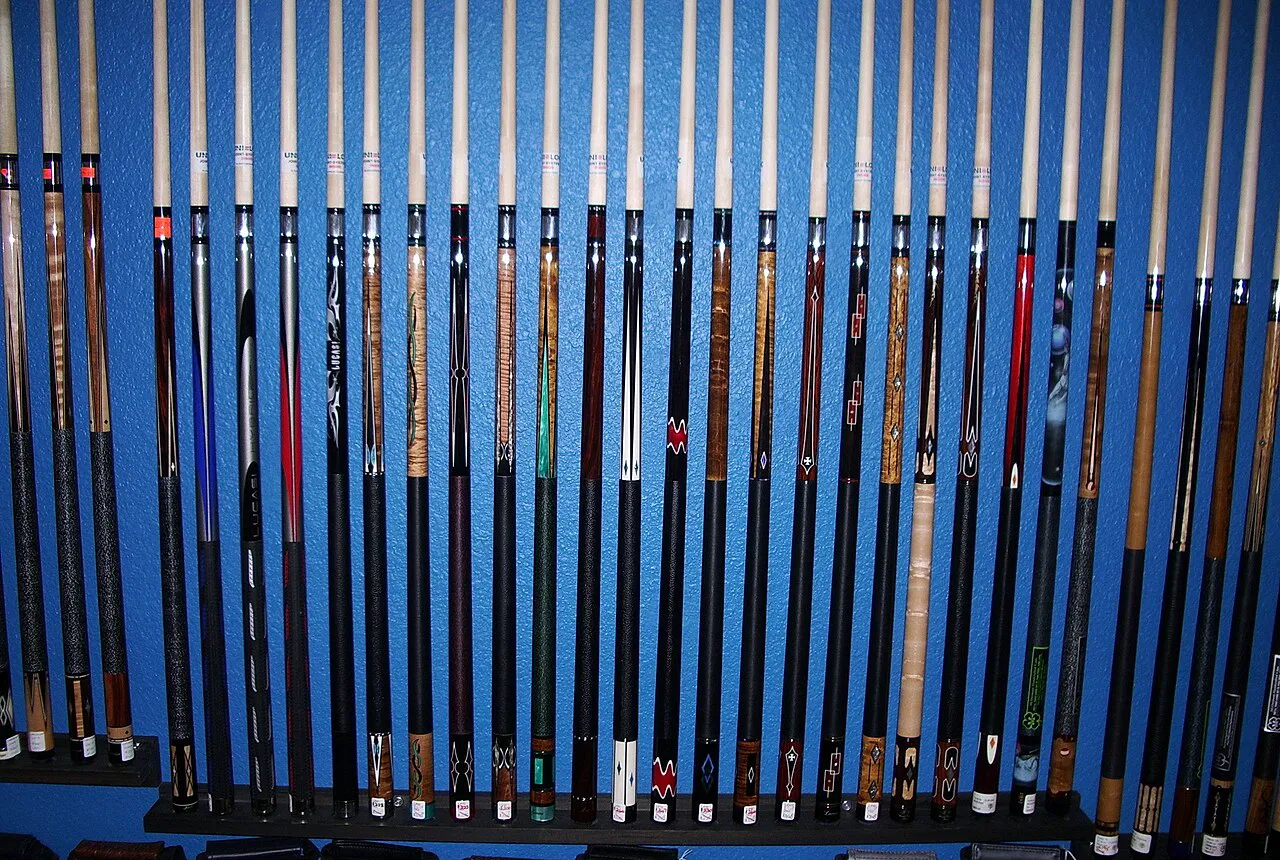
Ask a cuemaker what their cues are made of and you get a short lecture in botany: maple, ash, ebony, cocobolo, rosewood, bocote, ziricote. Ask a physicist what the wood does and the lecture shrinks to a sentence. Both answers are true at once — because the wood in a cue has two very different jobs, and only one of them is about how the cue plays.
The cue is really two pieces of wood doing two jobs
A two-piece cue is a shaft joined to a butt, and the wood in each half is chosen for different reasons.
The shaft is the working end — it slides through your bridge on every stroke and its last few inches decide how much the cue ball deflects on sidespin. Shaft wood is therefore chosen for mechanical behavior: straightness, stiffness, consistency.
The butt — forearm, points, handle, sleeve — is mostly architecture and appearance. Its wood sets the cue's weight, contributes to balance, and carries almost everything you actually see. This is where the exotic species live, and where most of the price ladder hides.
Maple: the default that won the shaft
Nearly every pool cue shaft on the planet is hard rock maple (Acer saccharum). McDermott's own materials notes call it the primary wood in every cue they build, sourced from the Great Lakes states and Canada, valued for strength, abrasion resistance and a fine, even texture. Wikipedia's cue stick entry says the same thing more bluntly: a typical pool cue is made mostly of rock maple.
Why did this one species win? It hits the rare intersection a cue shaft needs: dense enough to be stiff and durable at small diameters, even-grained enough to machine to a clean taper, and light enough in color to show a clean visual line against the cloth. No cheaper or more exotic alternative has ever beaten that combination for production work.
Two maple variants you'll see named on spec sheets:
- Birdseye maple — maple with a figured grain of small swirling "eyes"; prized and priced as a premium look. Cuemakers like Lambros offer it as a forearm upgrade precisely because it is a visual choice, not a different material.
- Curly (flame) maple — the same species with a rippled, shimmering figure across the grain. Again: the play properties are maple's; the surcharge is for the figure.
Ash: the other shaft wood
Ash is maple's only real rival, and its stronghold is snooker. Traditional British snooker cues are overwhelmingly ash, and makers describe the choice the way Mark Richard Cues does: ash is strong, slightly springy, and shows a pronounced visible grain — the "arrows" running down the shaft that many snooker players use as a built-in sighting aid while lining up a shot.
The maple-versus-ash comparison is really a trade of feel for look:
- Ash — a touch more natural flex, a livelier "feel," and that directional grain some players aim with. Retailer guides describe it as the softer-feeling option.
- Maple — denser and firmer on contact, with an almost invisible grain; the smoother shaft surface suits players who find ash's pronounced figure distracting.
Pool settled on maple, snooker on ash, and each camp finds the other's choice slightly odd. It is a genuine preference difference, not a right answer — which is why both species have survived for a century.
The exotic hardwoods: the butt is a jewelry case
The species names that drive cue prices up — ebony, cocobolo, rosewood, bocote, ziricote, tulipwood, snakewood, purpleheart, kingwood — almost never touch the shaft. They are butt woods: forearms, sleeves, inlay points and decorative veneers.
McDermott's exotic-woods rundown gives the honest picture of what each adds:
- African ebony — nearly black, extremely dense, indistinct grain. Used heavily in inlay work and high-end customs; availability is restricted by export bans, which is the main reason it costs what it costs.
- Cocobolo — orange-brown with black veining, from Central American uplands; very dense, takes a smooth finish. A staple of production "exotic" lines.
- Bocote — golden-brown with irregular black streaks; the most affordable of the exotics on McDermott's scale.
- Brazilian and East Indian rosewoods, tulipwood, ziricote — dark, dramatically figured woods used in sleeves, points and inlays; Brazilian rosewood is classed as an endangered species, so supply is genuinely constrained.
What do these species buy in playing terms? Weight and balance, mostly. Denser butt woods let a cuemaker put more of the cue's mass in the back half — one of the levers that sets the balance point covered in our balance point guide. Retailers also describe ebony and other dense exotics as producing a "heavier, more precise" hit — file that under maker and seller language, because there is no published test isolating butt species the way there is for shaft deflection.
Does the wood actually change how the cue plays?
Here is where honest sources split the question neatly:
Shaft material: yes, measurably. The maple-versus-carbon question is covered in our specs explainer and is carbon fiber worth the price — different stiffness, different endmass, different deflection behavior.
Butt species: essentially no. Dr. Dave Alciatore's cue-selection advice is deflating on purpose: equipment choice matters far less than players think — "it's the Indian, not the arrow" — and the only cue property with published measurement behind it is cue ball deflection, which lives in the shaft's front end. A cocobolo forearm and a stained maple forearm are the same cue once the shaft, tip, weight and balance match.
The makers partly disagree, and it is worth reporting their claim fairly: custom shops like Lambros state that forearm wood contributes to structural integrity and a consistent hit. What nobody on either side disputes is that the exotic wood's price is real — driven by scarcity, export restrictions and the labor of inlay work — whether or not a measurable performance difference follows it home.
One construction twist worth knowing: laminated shafts
"Wood" on a spec sheet can also mean engineered wood. Some shafts are laminated — layers or radial segments of maple glued into a blank rather than turned from a single board. Dr. Dave's explanation of why: lamination delivers better strength and dimensional stability from ordinary cuts of lumber, less warp over time, and less shaft-to-shaft variance than any single piece of wood can guarantee. Several low-deflection designs use laminated or pie-spliced construction for exactly this reason.
A related forum myth deserves a mention: the claim that a laminated shaft has a "spine" direction that changes deflection. Dr. Dave points to the cue-test-machine data showing no such effect.
The downside all wood shares: it moves
Whatever species you pick, wood is a living material that answers to humidity and temperature — every cue-care source agrees that all wood cues warp eventually. Exotic species don't dodge this; density is not warp immunity. The only real materials escape is carbon composite, which makers sell precisely as the shaft that doesn't move.
And if you're shopping used, wood condition is the whole inspection — dents, scratches, refinished forearms and rewraps are exactly what our used-cue checklist walks through.
The bottom line
The wood question has a boringly clean answer once you split the cue in two. The shaft is almost always maple (or ash if you play snooker, or carbon if you want out of wood entirely) — that choice is settled and mechanical. The butt woods are where money buys appearance: ebony, cocobolo, rosewood and friends are rare, beautiful and priced accordingly, and they change the cue's weight and balance, but not its hit in any published measurement. Buy the exotic forearm because you love how it looks — that's what it's for. Check the shaft, the straightness and the build quality for everything else; the pool cue specs explainer and the Cue Database carry the rest of that checklist. For a look at how far wood selection goes in a real shop, inside Jacoby's workshop shows the custom end, and why true splice cues cost more covers the construction the points belong to.
Sources
- Seybert's — The Different Pool Cue Wood Types — maple strength/consistency, ash as the softer-feeling classic, ebony described as a heavy, precise hit (seller language), rosewood and exotic woods overview
- McDermott — OnCue: Exotic Woods and the McDermott Cue — maple as primary cue wood (Great Lakes/Canada), cocobolo, bocote, ziricote, tulipwood, African ebony export restrictions, Brazilian rosewood scarcity
- Lambros Cues — Design — birdseye and curly maple forearms, the full exotic species list for points and veneers, and the maker claim that forearm wood affects structural integrity
- Mark Richard Cues — A Complete Guide to Snooker and Pool Cue Materials — ash vs maple tradeoffs, visible ash grain as an aiming aid
- Dr. Dave — Laminated Pool Cue Shafts — why shafts are laminated, warp resistance, the "spine" myth
- Dr. Dave — The Carbon Fiber Shaft Craze (Billiards Digest, Jan 2019) — "it's the Indian, not the arrow"; deflection as the one measurable cue property
- Wikipedia — Cue stick — rock maple as the standard pool cue wood, composite covering options
Cover photo: SMcCandlish, CC BY-SA 4.0, via Wikimedia Commons.
More coverage
Keep reading
Sneaky Pete Cue Explained: The House Cue That Isn't
A Sneaky Pete is a quality two-piece cue built to look like a cheap bar cue — plain outside, serious inside. The history, the tells, and what they cost.
Pool Table Cloth Compared: Simonis vs Gorina vs Andy
Walk into any forum thread about reclothing an American pool table and the same three names surface within minutes: Simonis, Gorina and Andy. All three make…
How to Refelt a Pool Table: Steps, Costs, and the Logo Rule
How refelting a pool table works: worsted vs woolen recap, precut kits, staple vs glue, the bed stretch sequence, rail wrapping, logo placement under the rail, and pro costs.