Layered vs One-Piece Pool Cue Tips: What the Layers Do
Pigskin pressed into a stack vs one slice of hide — the construction difference is real; what it buys you is still argued.
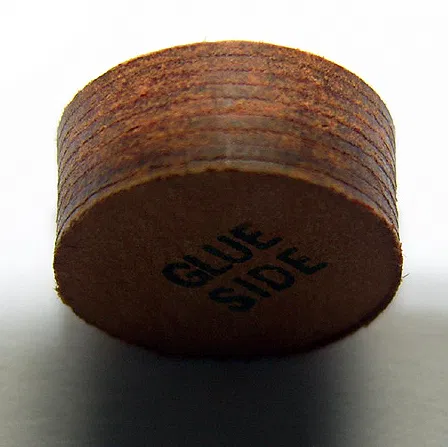
Every playing cue ends the same way: a small disc of leather glued onto the ferrule. What differs is how that disc was built — one thick slice of hide, or a stack of thin layers pressed and glued into a cylinder. You can see the difference with the naked eye, you pay extra for it, and players still argue about whether it matters.
One Piece vs a Stack
One-piece (solid) tips are cut from a single section of tanned hide — usually cow or buffalo leather — pressed to a target hardness and glued on whole. Le Pro, Triangle and Elk Master are the standard examples, and they are what ship on most house cues and much of the production market. Look at the side of one and the leather grain shows as irregular flecks, not stripes.
Layered (laminated) tips are built rather than cut: thin sheets of leather — most often pigskin — are compressed and glued into a stack, then turned to size. Kamui, Moori and Talisman are the established names. Kamui's own store describes its Standard tip as eight layers of pig leather; its Athlete model goes further and alternates four flexible layers with four rigid ones inside one stack, and its SAI break tip uses seven resin-treated layers. The tell on a laminated tip is a ring of thin, even lines around the side — sometimes dyed in alternating colors, exactly like the disc in the photo above.
A third category is worth one line: phenolic and composite break and jump tips are not leather at all, measure around 97 on the Shore D scale, and belong on a dedicated cue for the job rather than in this comparison.
Why Makers Layer the Hide
The case for lamination starts with the raw material. A hide is not homogeneous: as tip writer Jack Koehler put it in a quote republished by Dr. Dave, leather's texture and hardness change from the hair side inward — so a one-piece tip carries a simple hard-to-soft gradient through its thickness. Skived thin layers have the same internal variation, but stack enough of them with the grain randomized layer to layer and the finished disc averages out, ending up more homogeneous than any single slice can be.
Premium makers push that further with layer matching: each sheet is supposed to be the same thickness, hardness and elasticity before it goes into the stack. Tip tester Chris Renfro, in a breakdown quoted on Dr. Dave's site, credits that sorting step — not lamination itself — with the consistency premium layered tips deliver. He points to Navigator's vividly dyed layers as partly a production trick: the colors let workers group sheets by grade so a soft layer never lands in a hard tip. In cheaper laminated tips that skip matching, the stack gets graded after assembly instead — and a tip trimmed down during installation may not play at the hardness printed on the box.
What the Stack Is Claimed to Buy
- Consistency over the tip's life. A uniform stack is meant to hit the same after months of wear as it did new; laminated tips also hold their shape better than one-piece tips, per the cue-stick literature.
- Consistency tip to tip. Buy the same model twice, get the same hit — the real deliverable of layer matching.
- Chalk grip and rebound. Kamui markets its compression process as leaving the pigskin's pores open so chalk seats better — a manufacturer claim worth noting as such, not a lab result.
The Other Side of the Argument
- Glue lines. Every layer boundary is a line of adhesive, and skeptics hold that the glue changes how the tip compresses or holds chalk. Dr. Dave's verdict is blunt: in the absence of hard comparison data, laminated versus solid is a matter of personal preference and psychology.
- Delamination. The one failure mode only layered tips have — a layer peeling apart, or the stack coming apart entirely. It is uncommon and usually traces to a poor installation, abuse from tip tools, or repeated high-impact massé shots. One-piece tips cannot delaminate, but they mushroom more easily in exchange.
- Price. Lamination is a longer manufacturing process, so layered tips cost more — Kamui's listed price for its Standard tip runs roughly $27–34 against a few dollars for a solid tip. (Retailer hardness data for Kamui Original, for what it is worth: Soft 62.6, Medium Soft 70.3, Medium 73 and Hard 81.9 on Shore D.)
- Durability. Renfro actually gives the durability edge to solid tips: a soft or medium laminated tip drifts toward about 76 Shore D over time like everything else — the drift our tip hardness guide covers — while a solid tip's character is set by fiber size and pressing, which is why an over-pressed Elk Master never becomes a true hard tip.
What Construction Does Not Change
- Spin and the miscue limit. Dr. Dave's bottom line on tip types: as long as a tip holds chalk there is no significant performance difference in miscue limit or maximum spin between types — those are decided by chalk and by how far off center you strike, not by how the disc was assembled.
- Hardness. Both constructions span the whole scale. The community-measured chart Dr. Dave republishes puts solid-leather Blue Diamond near 61 and Le Professionel near 78, while laminated Moori Soft sits at 64 and Kamui Black Medium at 78. Construction does not tell you the grade — the brand's own letter does, and only inside that brand.
Which One to Buy
- Play what the cue shipped with. Any repair shop swaps a tip in minutes, so this stays the cheapest experiment in the sport — pick the cue for its weight, shaft and diameter instead.
- If you go aftermarket: a premium layered tip from Kamui, Moori or Talisman is the consistency play; a solid tip like Le Pro, Elk Master or Blue Diamond is the cheap, proven baseline many league players never leave.
- Watch wear, not the calendar. Glaze, mushrooming and a dome worn flat are the real replacement signs — our when-to-replace guide lists them, and tip shape and hardness change more about your hit than construction does.
- Let the install count. Most delamination stories start with a bad glue job, so a shop install — or careful surface prep at home — beats a rushed swap.
For the adjacent question of whether pricier chalk and tips actually buy spin, sister site Billiard News ran the same skeptic's pass on chalk, tips and miscues.
Are layered cue tips better than one-piece tips?
Not measurably, as a rule. Lamination makes the leather more uniform and layered tips hold their shape longer, but Dr. Dave notes there is no hard comparison data showing a performance edge — most of the gap is preference. Premium layered tips do deliver real batch-to-batch consistency, which is what their price buys.
How many layers does a Kamui tip have?
Kamui's own store lists its Standard tip as eight layers of pig leather; the Athlete alternates four flexible and four rigid layers, and the SAI break tip uses seven resin-treated layers.
Why did my layered tip come apart?
Delamination — a layer separating from the stack — is the one failure unique to laminated tips. It is uncommon, and the usual causes are a poor installation, damage from tip tools or repeated high-impact massé shots rather than the design itself.
Do pros use layered or solid tips?
Both. Laminated tips dominate premium aftermarket sales, but solid tips like Le Pro and Elk Master remain in use at every level. Pros who care most about consistency typically replace tips on a schedule regardless of construction.
Sources
- Dr. Dave — layered cue tips
- Dr. Dave — cue tip types and selection
- Dr. Dave — tip hardness comparison chart
- Wikipedia — cue stick (tip section)
- Kamui — tip series and construction
- Kamui — Standard Black tip (listed price)
- Mueller's — Kamui Original laminated tip (hardness data)
- Billiard News — pool chalk, cue tips and miscues
More coverage
Keep reading
Sneaky Pete Cue Explained: The House Cue That Isn't
A Sneaky Pete is a quality two-piece cue built to look like a cheap bar cue — plain outside, serious inside. The history, the tells, and what they cost.
Pool Cue Wood Types: Maple, Ash, and What the Exotics Do
Maple rules the shaft, ash owns snooker, and ebony, cocobolo and rosewood dress the butt. What cue woods actually change — and what is decoration.

Pool Table Cloth Compared: Simonis vs Gorina vs Andy
Walk into any forum thread about reclothing an American pool table and the same three names surface within minutes: Simonis, Gorina and Andy. All three make…