What Is a Pool Cue Ferrule? What That White Ring Actually Does
That white ring under the tip does more than look nice — it keeps the shaft from splitting, hosts every retip, and even nudges how much the cue ball squirts.
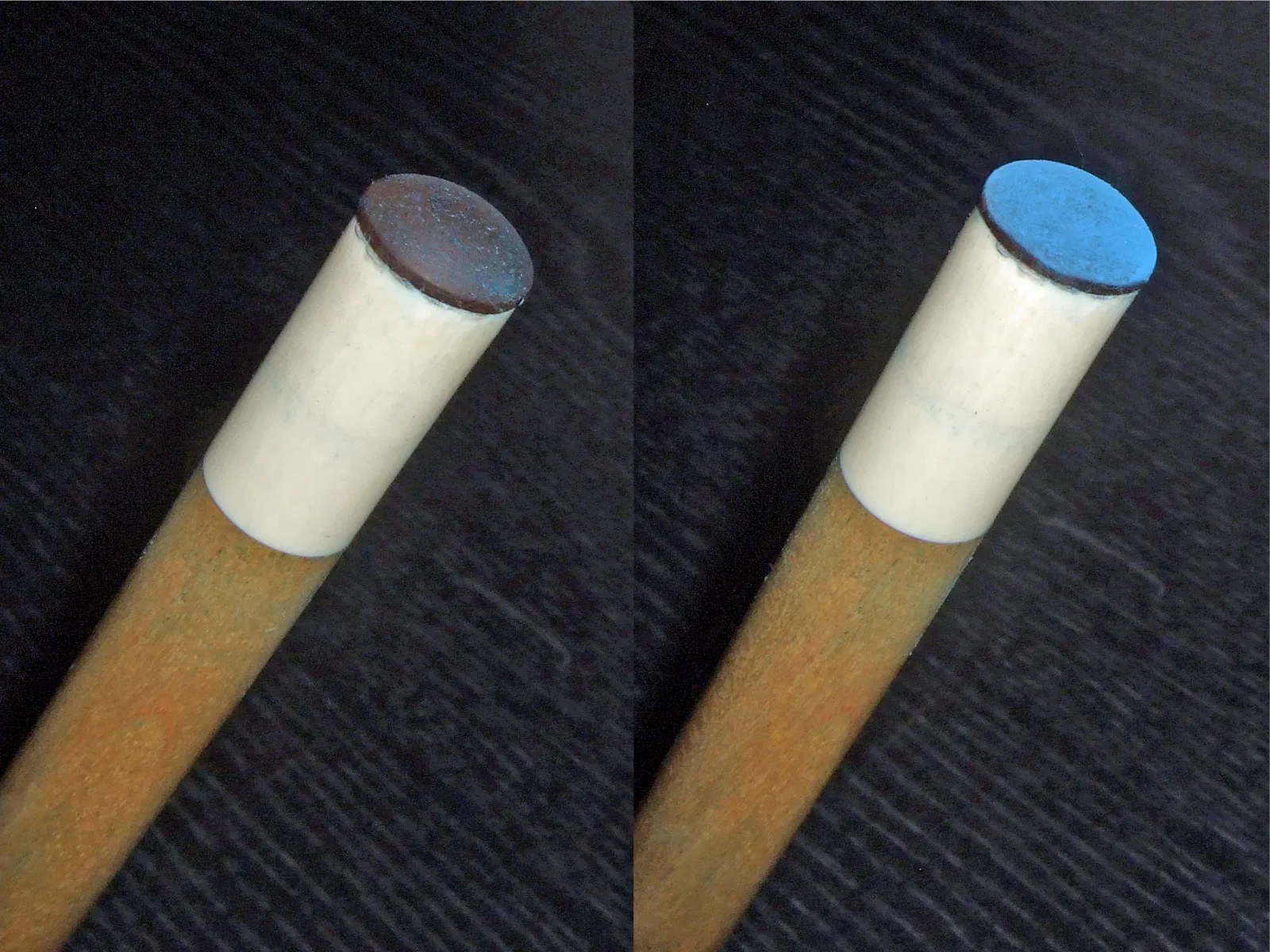
Every pool cue ends the same way: a leather tip on top, and right under it a short, pale collar most players never look at twice. That collar is the ferrule — the only part of the cue standing between the shaft's end grain and the impact of every shot you ever hit.
What the ferrule does
On a typical wood shaft the ferrule is a sleeve roughly 0.75–1 inch (19–25 mm) long. On most shafts it sits over a tenon — a narrow stub turned into the end of the shaft — and is glued or screwed on. You never see the tenon unless the ferrule comes off.
Its jobs, per cue builders and Dr. Dave Alciatore's ferrule FAQ:
- Protect the end grain. Maple is strong along its length but splits easily across the end. Every shot drives the tip back into the shaft; the ferrule takes that impact across its whole face so the wood underneath doesn't crack or mushroom.
- Give the tip a flat platform. Tip glue needs a hard, flat surface, and the ferrule provides it.
- Save shaft wood over the cue's life. Each retip is faced off the ferrule rather than the wood, so the shaft doesn't get shorter every time the tip is replaced. It also keeps chalk and moisture off the end grain at the spot that sees the most contact.
- Shape the hit's character. Ferrule material affects the cue's look, feel and the sound of contact — though how much it changes the hit itself is debated (more on that below).
Why ferrule weight matters for aim
The ferrule lives inside the zone cue engineers call the endmass — the last several inches of the shaft. Dr. Dave's squirt tests at Colorado State found that mass added near the tip increases cue-ball squirt (deflection) the most, while mass added more than about 7 inches back made no measurable difference on the cue tested.
That is why low-deflection shafts attack endmass three ways: a smaller tip diameter, a hollowed-out shaft end, and a lighter or smaller ferrule. Ferrule material is typically denser than wood, so two shafts with the same taper can squirt differently purely because of what sits under the tip. Our low-deflection guide digs into the squirt side of that story.
What ferrules are made of
| Material | Where you see it | What to know |
|---|---|---|
| Linen-melamine (Aegis II) | Most production cues | Linen-impregnated thermoset that machines cleanly and bonds with epoxy or CA glue — the modern default |
| Ivorine-type synthetics | Many production cues | Ivory-look plastic, a common stand-in for real ivory |
| Juma | Custom and mid-range cues | Synthetic ivory substitute stocked by cue makers and repair shops |
| Linen / black fiber | House and budget cues | Tough and cheap; damps vibration at contact |
| Phenolic | Break and jump cues | Very hard resin from the same family used for billiard balls — usually paired with a phenolic tip |
| Horn | Custom work | Natural material; boutique installs run $50–60 |
| Ivory | Vintage and older custom cues | Prized for feel; US federal rules have barred most commercial trade in African elephant ivory since 2016 — where shops still offer it, installs run $125 or more |
| Proprietary / capped | Low-deflection shafts | Maker-specific designs; on some brands, outside ferrule work can void the warranty |
| None | Carbon-fiber shafts | Predator's REVO replaces the ferrule with a thin "Vault Plate" under the tip — offered in white for players who like sighting on a pale ring |
Snooker cues live in a different world: brass is the standard ferrule material there, not the synthetics above.
When the ferrule cracks, spins or clicks
Because the tenon is what actually holds the ferrule, a ferrule that spins or clicks usually means the glue joint has failed — and a hard knock that snaps the ferrule can take the tenon with it. A crack, even a hairline, is a cue-tech job: shops typically charge $40–50 for a ferrule replacement plus a new tip. Matching the material the cue came with is the safe default unless you're deliberately trying to change the hit.
A worn tip won't wait for a cracked ferrule, though — see when to replace a pool cue tip for the maintenance side of that front end.
Does the ferrule matter when you buy?
Mostly no. You don't choose a ferrule — you choose a shaft, and the ferrule comes with it. Players argue endlessly about which material "hits best," but the claims don't line up between sources, and even Dr. Dave is skeptical that a hard ferrule detectably stiffens the hit compared to the same wood without one; what it reliably changes is the sound of contact. The measurable differences are weight and length, and both are already baked into a shaft's deflection design.
So treat the ferrule as something to inspect, not something to shop for: sight down it for cracks before you buy used, and let the specs that actually move the needle — weight, tip diameter and shaft material — drive the decision. The Cue Database lists what ships on current models.
Sources
More coverage
Keep reading
Sneaky Pete Cue Explained: The House Cue That Isn't
A Sneaky Pete is a quality two-piece cue built to look like a cheap bar cue — plain outside, serious inside. The history, the tells, and what they cost.
Pool Cue Wood Types: Maple, Ash, and What the Exotics Do
Maple rules the shaft, ash owns snooker, and ebony, cocobolo and rosewood dress the butt. What cue woods actually change — and what is decoration.
Pool Table Cloth Compared: Simonis vs Gorina vs Andy
Walk into any forum thread about reclothing an American pool table and the same three names surface within minutes: Simonis, Gorina and Andy. All three make…