Valhalla Cue Guide: Maple, Carbon, Break and Jump Models
Valhalla now spans $140 maple playing cues, $399 carbon models and dedicated break/jump options. The right choice starts with the cue’s job, not its graphics.
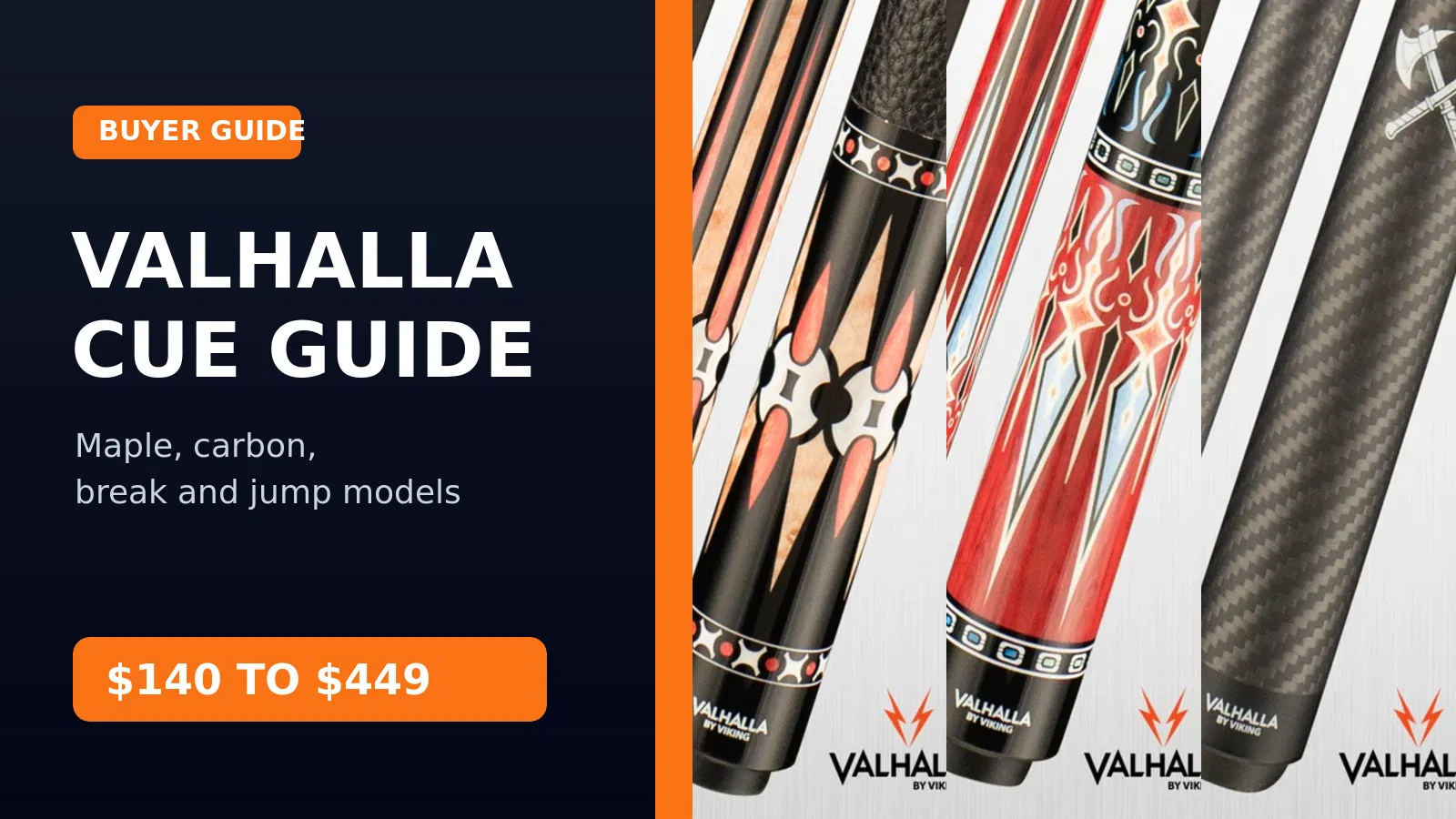
Valhalla's current catalog covers four distinct jobs: affordable maple playing cues, style-led Garage models, carbon-shaft playing cues, and dedicated break/jump equipment. The listed prices checked on November 4, 2026 run from $140 for the VA109 and VA110 to $449 for the VA-BRKC carbon break/jump cue.
The short answer is simple. Choose the VA109 or VA110 if you want a low-cost maple playing cue, a Garage model if linen and brighter finishes matter, the VC01 or VC02 if you want Valhalla's least expensive carbon playing configuration, and a dedicated H-Series or VA-BRKC only for breaking and jumping. A break cue is not a substitute for a playing cue.
What are the main Valhalla cue choices right now?
The range makes more sense when models are grouped by purpose rather than model number.
| Representative model | Listed price* | Intended job | Shaft and tip | Wrap | Published weight | Joint |
|---|---|---|---|---|---|---|
| VA109 | $140 | Playing | Hard rock maple, premium leather | Wrapless | Not stated on product page | 5/16 x 18 |
| VG026 | $175 | Playing | Hard rock maple; tip description is inconsistent on the page | Linen | Not stated on product page | 5/16 x 18 |
| VC01 | $399 | Playing | 12.50 mm carbon with dual-density fill, 7-layer soft leather | Wrapless | 19 oz | 5/16 x 18 |
| VC04 | $425 | Playing | 12.50 mm carbon with dual-density fill, 7-layer soft leather | Embossed litchi leather | 19 oz | 5/16 x 18 |
| VA-BRK-H1 | $250 | Break/jump | Maple, Reactor break tip | Wrapless | 25 oz, fixed | 5/16 x 18 |
| VA-BRKC | $449 | Break/jump | 13 mm carbon, extra-hard break tip | Wrapless | 19 oz | 5/16 x 18 |
*Prices are the current amounts displayed by Viking/Valhalla when checked, not a promise of future pricing or local dealer stock.
This table deliberately compares representative configurations. Valhalla lists more color and graphic variants within each family, so two nearby model numbers can share the same functional specification.
What changes between the $140 and $175 maple cues?
At the entry point, the VA109 and VA110 are $140 wrapless playing cues. Viking lists a North American hard rock maple shaft, pro taper, premium leather tip, high-impact resin ferrule, ultraviolet urethane finish, stainless-steel 5/16 x 18 pin and an interchangeable weight system for the VA109. The VA109 uses an autumn stain; the VA110 uses mahogany stain.
Moving to the $150 VA119 or VA120 mainly adds a linen wrap. The $160 VA214 changes the decoration, while the $225 VA486 adds point-and-veneer graphic transfers and linen. These are model-level distinctions in finish and grip, not evidence that one cue produces better results on the table.
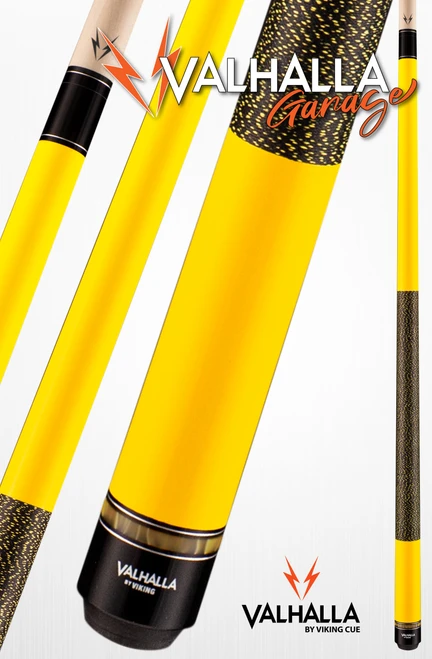
The Garage line sits at $175 in the source catalog. Models VG021 through VG027 pair maple construction with linen, pearlescent paint and decorative rings. The step from $140 to $175 is therefore easier to justify for a player who specifically wants a linen grip and the Garage appearance. It is not an automatic performance upgrade.
There is one catalog detail buyers should notice: the Garage product headline may identify a Tweeten Triangle tip, while the specification block can say premium leather. Because those two descriptions conflict on at least one current page, confirm the fitted tip with the seller before ordering if tip brand matters.
Which Valhalla Carbon model offers the clearest value?
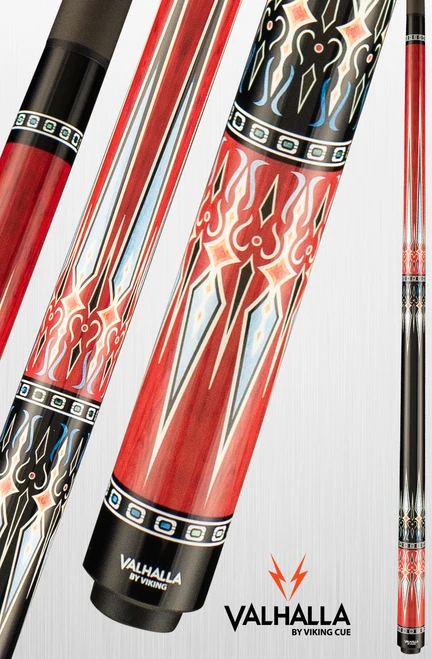
The VC01 and VC02 are the lowest-priced carbon-shaft playing cues in the checked lineup at $399. Both use a wrapless engineered-maple butt, 12.50 mm carbon-fiber shaft with dual-density fill, pro taper, 7-layer soft leather tip, 5 mm high-impact ferrule and 5/16 x 18 joint. Viking publishes a standard weight of 19 ounces and includes a nylon protective sleeve plus joint protectors.
At $425, VC03 through VC06 retain the same published shaft diameter, fill, tip, joint and 19-ounce weight. Their functional headline difference is the embossed litchi leather wrap and their individual graphic treatments. The extra $26 is best viewed as a grip-and-finish decision unless a dealer documents another model-specific change.
Players who dislike the feel of leather under the rear hand have a clean answer: select VC01 or VC02. Players who want a defined wrap texture can look at VC03 through VC06. None of the manufacturer specifications establishes that one graphic variant is more accurate than another.
Is a carbon shaft automatically better than maple?
No. The catalog identifies construction, diameter and taper, but it does not provide a controlled comparison of deflection, vibration, durability or scoring performance between the maple and carbon models.
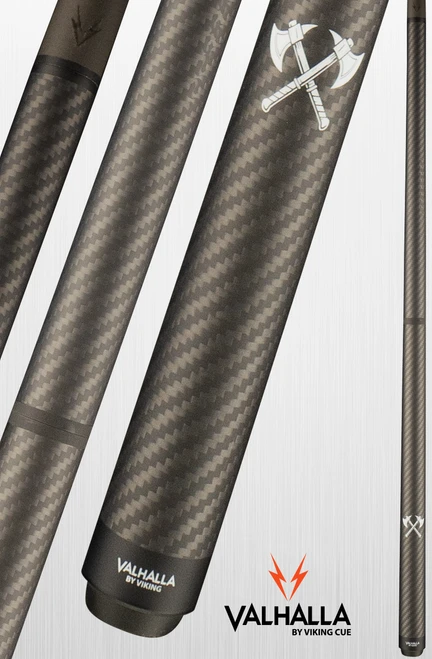
The published difference is concrete: the standard and Garage cues use hard rock maple shafts, while the Carbon Series uses a 12.50 mm carbon shaft with dual-density fill. That can change the sound, feedback and maintenance routine. It does not establish universal superiority because players value those traits differently.
A buyer moving from a familiar 13 mm maple shaft should also treat 12.50 mm as a meaningful fit choice. The smaller published diameter changes the visual reference at address and may feel different in a closed bridge. Trying the diameter first is more useful than buying solely because “carbon” appears in the name.
Which cue should be used for breaking and jumping?
Valhalla lists separate tools for these shots. The VA-BRK-H1 and VA-BRK-H2 cost $250 and use a three-piece maple break/jump format. Viking specifies a fixed 25-ounce weight and a Reactor break tip for the H1. That is a deliberately heavy configuration, so players who prefer a quicker, lighter break stroke should test it before buying.
The VA-BRKC costs $449 and is also a three-piece break/jump cue, but it uses a 13 mm carbon-fiber shaft, strong taper, 3 mm high-impact ferrule and premium extra-hard break tip. Its listed 19-ounce weight and interchangeable weight system make it materially different from the fixed 25-ounce H-Series configuration.
Those specifications do not prove that the $449 model transfers more energy. They show two different approaches: heavy maple at $250 versus lighter carbon at $449. Stroke speed, cue-ball control and the break rules used in your game remain part of the decision.
The VA-JMP2C at $399 is a dedicated jump cue rather than a combined playing cue. Buy it only if a separate jump tool suits the rules you play under and the tournaments or rooms where you compete allow jump cues.
Does the 5/16 x 18 joint guarantee shaft compatibility?
No. A shared thread label is not a complete compatibility test. Pin length, pilot geometry, collar diameter and facing can still differ.
Viking states on its Valhalla product pages that the cues may not work with certain non-Viking aftermarket products. Most models in this guide list a 5/16 x 18 joint, while VA703, VA704 and VA705 are identified by Viking as exceptions using a piloted 5/16 x 18 quick-release joint.
If you plan to reuse a shaft, ask the shaft maker or an authorized dealer to confirm the exact model pairing. Do not infer a safe fit from “5/16 x 18” alone, and do not force a shaft that binds or leaves a gap at the joint face.
What does the lifetime warranty actually require?
Viking advertises a lifetime warranty for Valhalla cues, including warpage, but the full warranty terms matter. The cue must be bought from an authorized retailer or distributor, registered within 60 days and submitted with the original receipt. Coverage belongs to the original owner and is not transferable.
The entire cue must accompany a claim. Replaceable or wear-related components can be excluded, and aftermarket products, mishandling, abuse or unauthorized repair can void coverage. For covered Valhalla claims, Viking says repair or replacement with the same model or one of equal value is available one time, at the company's discretion.
That is useful protection, but it should not be summarized as unrestricted lifetime replacement. Keep the receipt, register promptly and check the current terms before modifying the cue.
Which Valhalla cue fits each type of buyer?
- First personal playing cue: VA109 or VA110 at $140, especially if a wrapless maple cue and basic adjustable-weight platform meet your needs.
- Linen-grip buyer: VA119 or VA120 at $150 for a restrained finish, or a $175 Garage model for pearlescent paint and stronger visual styling.
- Wrapless carbon buyer: VC01 or VC02 at $399. Their published playing specifications match the central Carbon Series format without the leather-wrap premium.
- Leather-wrap carbon buyer: VC03, VC04, VC05 or VC06 at $425. Choose among them primarily by graphic design.
- Heavy break/jump buyer: VA-BRK-H1 or H2 at $250, provided the fixed 25-ounce specification suits your stroke.
- Lighter carbon break/jump buyer: VA-BRKC at $449, with the caveat that its extra cost is not proof of better break results for every player.
Budget for a case, chalk, tip maintenance and any dealer setup separately. The product prices do not tell us whether local tax, shipping or optional weight changes are included.
What information still needs confirmation before purchase?
The source pages do not establish live inventory at every dealer, delivery time, exact assembled length for every model or the default weight of every maple cue. The Garage tip wording is also inconsistent between headline and specification text on at least one page.
Price and availability can change after publication. For a model that is backordered, ask whether the seller has the exact SKU shown, not only another cue from the same series. Color and wrap photos can also look different under room lighting, so returns and exchange terms deserve a check before ordering.
What is the bottom line on the Valhalla lineup?
The VA109 and VA110 are the straightforward value choices when the goal is an affordable maple playing cue. The VC01 and VC02 are the price-conscious carbon choices because they retain the published Carbon Series shaft specification at $399. The VC03 through VC06 ask $26 more for a wrapped grip and different graphics.
For break and jump use, decide first between the fixed 25-ounce maple H-Series and the 19-ounce carbon VA-BRKC. They are different tools, not a simple good-better-best ladder. No manufacturer data or independent controlled test reviewed for this guide supports declaring one model the best-playing cue for everyone.
What is the cheapest Valhalla cue in the current lineup?
The VA109 and VA110 were listed at $140 when checked on November 4, 2026. Both are wrapless maple playing cues with a 5/16 x 18 joint and interchangeable weight system.
What is the cheapest Valhalla carbon playing cue?
The wrapless VC01 and VC02 were listed at $399. Viking specifies a 12.50 mm carbon shaft with dual-density fill, pro taper and 7-layer soft leather tip.
Are Valhalla Carbon cues made entirely from carbon fiber?
No. The published configuration combines a carbon-fiber shaft with an engineered-maple butt. “Carbon Series” does not mean the complete cue is carbon fiber.
Can a Valhalla break/jump cue be used as a regular playing cue?
It can strike a ball, but its hard tip, taper and break-focused construction are not intended to replace a regular playing cue. Using separate tools also protects the playing tip from repeated break impact.
Do all Valhalla cues use the same joint?
Most current models discussed here list 5/16 x 18, but Viking names VA703, VA704 and VA705 as piloted quick-release exceptions. Aftermarket fit still needs model-specific confirmation.
More coverage
Keep reading
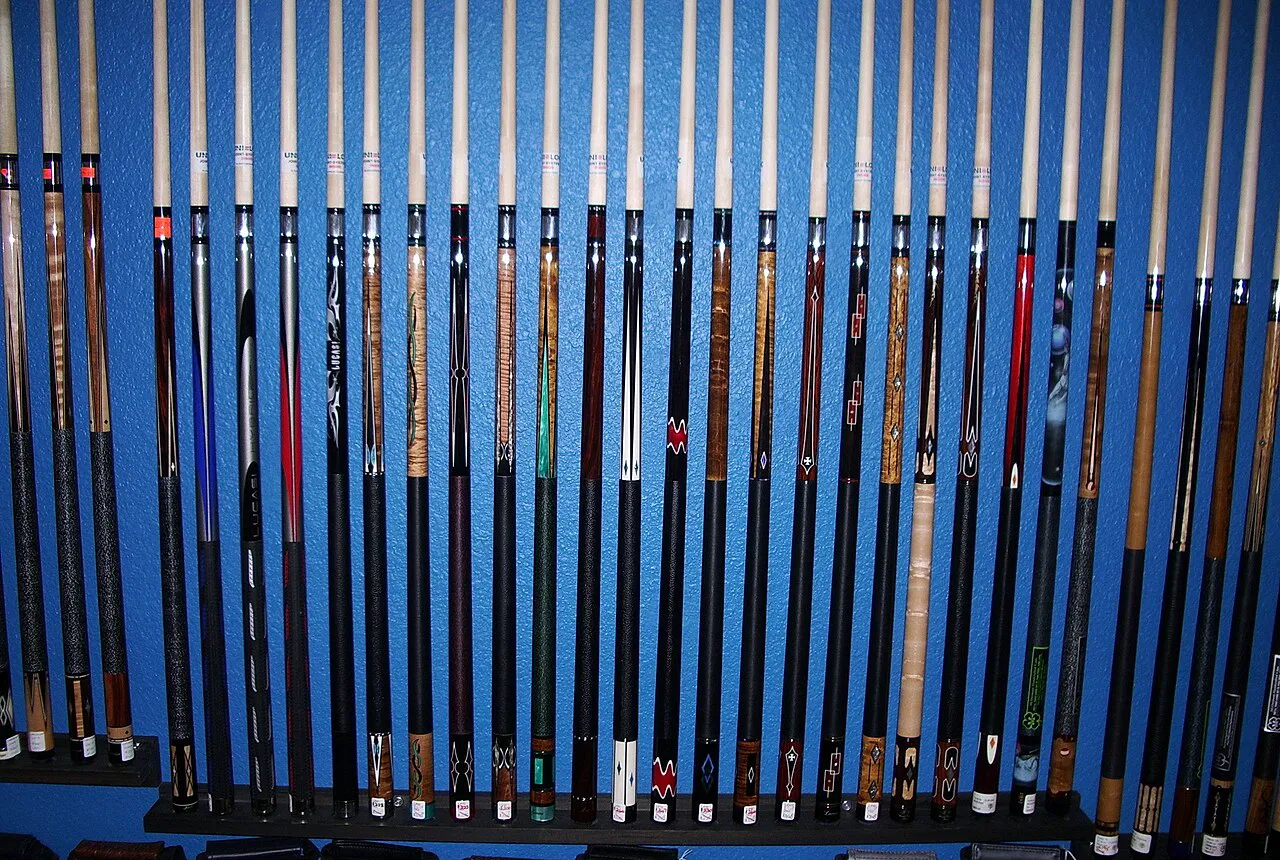
Pool Cue Wood Types: Maple, Ash, and What the Exotics Do
Maple rules the shaft, ash owns snooker, and ebony, cocobolo and rosewood dress the butt. What cue woods actually change — and what is decoration.
Pool Table Cloth Compared: Simonis vs Gorina vs Andy
Walk into any forum thread about reclothing an American pool table and the same three names surface within minutes: Simonis, Gorina and Andy. All three make…
How to Refelt a Pool Table: Steps, Costs, and the Logo Rule
How refelting a pool table works: worsted vs woolen recap, precut kits, staple vs glue, the bed stretch sequence, rail wrapping, logo placement under the rail, and pro costs.