Break Cue vs Playing Cue: Do You Need Both?
Walk into any pool hall on league night and the serious players unzip cases holding two cues: one they play with, and one that exists for exactly ten seconds of every rack — the break. Dr. Dave Alciatore's advice on the subject is blunt: it is best to break with a dedicated break cue, and power breaking with your normal playing cue can damage it over time. But a dedicated cue is a second purchase, so the honest question is who actually needs one.
What a Break Cue Is Built to Do
A break shot asks for one thing: maximum cue ball speed delivered squarely into the rack, hundreds of times over a cue's life. Playing cues ask for the opposite — finesse, spin and a touch that survives a thousand soft shots. Manufacturers build break cues around that single violent job, and Dr. Dave describes them as "beefier" sticks with hard, usually phenolic tips.
Every design difference below traces back to that job description.
The Design Differences
Tip: leather versus phenolic. Playing cues wear leather tips — layered hide in soft, medium or hard grades that holds chalk and shapes easily, covered in our tip hardness guide. Break cues typically wear phenolic, a synthetic so hard it barely resembles a playing tip: on the community-measured Shore D charts republished on Dr. Dave's site, phenolic break tips measure around 97, where leather playing tips sit anywhere from the high 50s to the high 70s.
The payoff is measurable. Dr. Dave's cue efficiency testing puts the coefficient of restitution — how much of your stroke's energy actually reaches the cue ball — at roughly 0.71–0.75 for leather playing tips and 0.81–0.87 for phenolic break and jump tips. Run through the break-power math, that gap is worth about 17% more breaking power for the same cue speed. The cost: phenolic barely holds chalk and offers almost no finesse, which is exactly why nobody plays position with one.
Ferrule: softer cushion versus solid hammer. Playing cues commonly carry a 0.75–1 inch ferrule of fiberglass or phenolic resin that cushions the tip bond. Break cues run harder ferrule materials — phenolic or similar high-impact compounds — and some designs integrate tip and ferrule into a single hard front end. Both approaches chase the same thing: less energy lost to deformation at impact.
Shaft and taper: whippy versus stiff. A playing shaft usually carries a long pro taper — a slim, gradually widening profile that lets the cue slide through the bridge hand and flexes a little on the stroke. Break shafts go the other way: cue-building references describe break shafts as commonly using a conical (European) taper — widening steadily toward the tip — because a stiffer shaft wastes less stroke energy to flex. Tip diameters run bigger too, commonly 13–14 mm on break and jump cues where playing shafts cluster around 12–13 mm.
Weight: a different debate entirely. Playing cues span 17–21 oz with 19 as the default — the physics of which our cue weight guide covers in detail. Break cues sit in the same range but the debate reshuffles: heavier adds a little ball speed (going 17→22 oz at identical cue speed gains only ~6.3% cue ball speed in Dr. Dave's TP A.30 analysis), while lighter cues are easier to accelerate — so some players genuinely break harder with less cue. Some mass-market break cues lean deliberately heavy, like the Rage Heavy Hitter sold at 25 oz.
Joint and grip: quick release and traction. Because a break cue gets assembled, swung hard and packed away again, quick-release joints are common — the same hardware covered in our joint types guide. Wraps skew toward tacky sport grips or wrapless finishes rather than linen, since a slipping back hand ruins a power break.
What Breaking Costs Your Playing Cue
The case for a second cue is not just performance — it is wear. A leather tip is shaped and compressed to a precise dome; a power break slams it flat a little more each time. Dr. Dave's warning covers both halves: repeated power breaking flattens the tip and can cause cumulative damage to the cue itself. A $25–35 replacement tip is cheap, but it arrives with a break-in period and a reshaping — an annoying tax if you break hard every rack, every week.
When You Need a Dedicated Break Cue — and When You Don't
You probably do if: you play leagues or tournaments where breaking well matters weekly; you break hard enough to notice your playing tip mushrooming or flattening early; or you want the phenolic-tip speed bonus without giving up your playing tip's chalk grip.
You probably don't if: you play a few casual racks a month — house-cue breaks cost you nothing; your league restricts the equipment (some leagues and tournaments prohibit dedicated break cues or phenolic tips specifically because of the advantage they confer, and because a phenolic tip can damage the cue ball on a very strong break); or your budget is better spent on the playing cue itself first. Dr. Dave's own caveat applies here: proper break technique matters far more than break cue choice — a good breaker can break well with any cue.
The Break-Jump Combo: Two Tools, One Slot
Most mid-priced dedicated breakers are actually break-jump cues — a three-piece design where the butt unscrews a second time, leaving a short, light assembly for jump shots. Jump portions commonly run around 40 inches, the minimum legal length for a jump cue. You get a break cue and a legal jumper in a single case slot, which is why the format dominates: the Viking CRUSH and Pure X HXT comparison shows how far manufacturers take the idea — the HXT builds five configurations around the concept.
If you want a dedicated jumper instead, our jump cue roundup covers that category on its own.
What They Cost
Sourced retail listings checked October 28, 2026:
- Entry dedicated breakers: around $125–160 — Rage maple break cues at Seybert's, including the 25 oz Heavy Hitter variants.
- Mid-range break-jump combos: roughly $230–450 — Players JB models listed at $227–237 at Seybert's; Mueller's lists the Star S2 at $285, the Stinger at $380, and the RAT-JB1 at $450.
- Flagship performance breakers: $430–850+ — Predator's BK4 line lists at $429–469 and the carbon-shafted BK Rush at $849 at Seybert's; our Tiger IMPAKT vs Pechauer Rogue comparison covers the $800–950 end.
For context, a solid playing cue purchase starts in the same $150–250 range — so "two cues" does not mean doubling your budget if the breaker comes from the entry tier.
The Bottom Line
A break cue is cheap insurance plus a measurable physics bonus: about 17% more break energy from the tip material alone, and an end to flattening the tip your actual game depends on. Casual players can break with the playing cue and lose nothing that matters. League players who break hard every week — and anyone already shopping a break-jump combo — have the clearest case for the second cue. The rest of the decision lives in the spec guides: cue specs explained, weight, tip hardness and joints, plus the model listings in the Cue Database.
Sources
- Dr. Dave — Break Cue Advice — dedicated break cue recommendation, damage to playing cue, pivot-length matching, leagues banning phenolic tips
- Dr. Dave — Cue Tip Efficiency — COR 0.71–0.75 leather vs 0.81–0.87 phenolic, ~17% break-power gain
- Dr. Dave — Cue Types and Tapers — conical break taper, 14 mm break/jump tips, break-jump construction, ~40" jump minimum
- Dr. Dave — Optimal Cue Weight + TP A.30 — 17→22 oz gains ~6.3% cue ball speed at identical stroke speed
- Dr. Dave — Tip Hardness Chart — Shore D figures, phenolic ~97
- Wikipedia — Cue stick — playing cue lengths/weights, ferrule construction
- Seybert's — Break Cues and Players Jump/Break Cues — retail prices for Rage, Players JB, Predator BK4 and BK Rush
- Mueller's — Star S2 $285, Stinger $380, RAT-JB1 $449.95 listings
More coverage
Keep reading
Sneaky Pete Cue Explained: The House Cue That Isn't
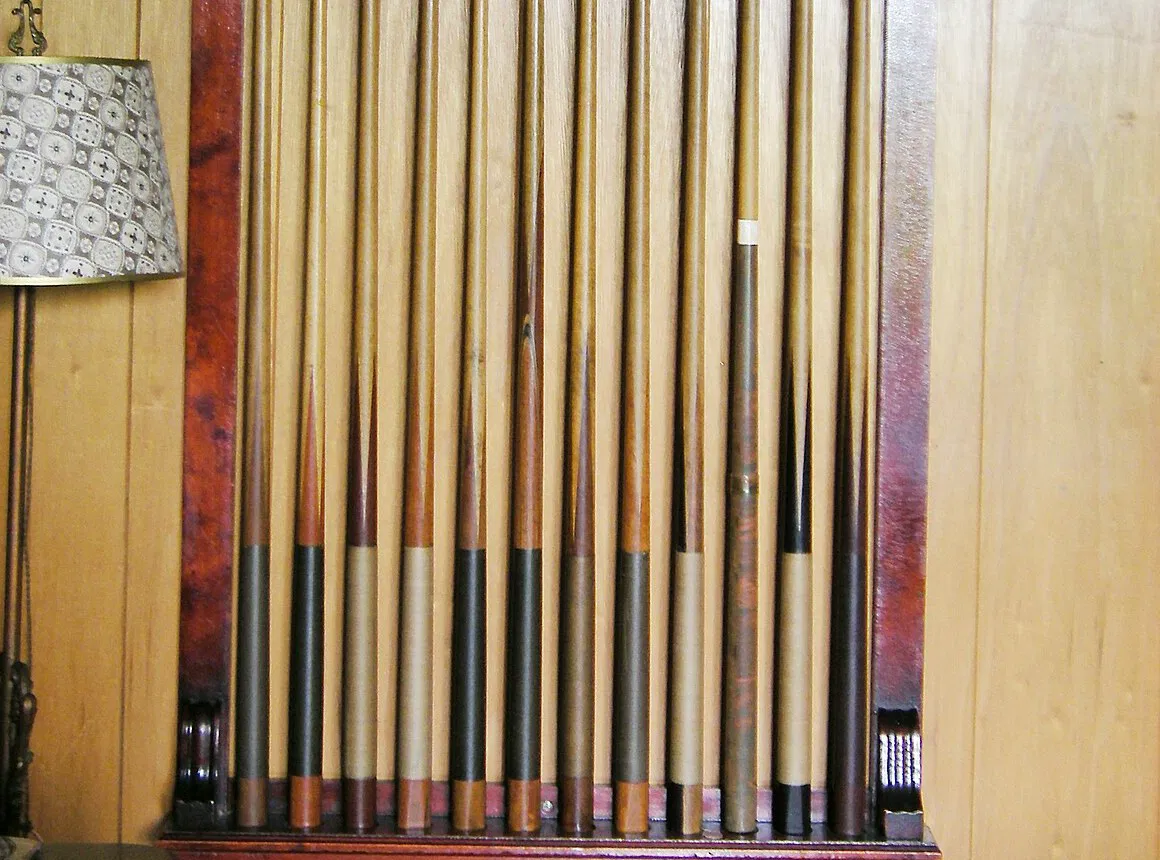
A Sneaky Pete is a quality two-piece cue built to look like a cheap bar cue — plain outside, serious inside. The history, the tells, and what they cost.
Pool Cue Wood Types: Maple, Ash, and What the Exotics Do
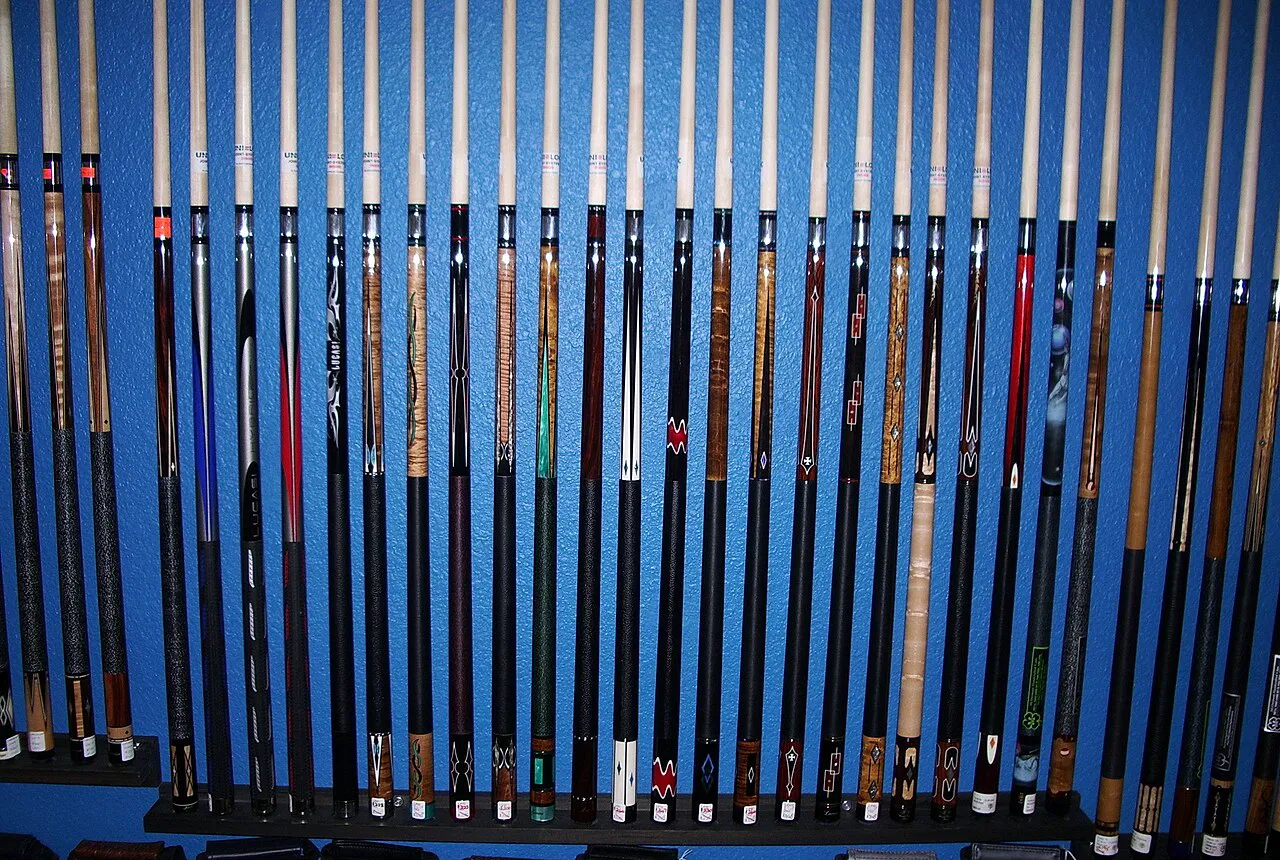
Maple rules the shaft, ash owns snooker, and ebony, cocobolo and rosewood dress the butt. What cue woods actually change — and what is decoration.
Pool Table Cloth Compared: Simonis vs Gorina vs Andy
Walk into any forum thread about reclothing an American pool table and the same three names surface within minutes: Simonis, Gorina and Andy. All three make…