How to Choose the Right Pool Cue Weight: 18, 19 or 21 oz
Three ounces is barely anything on a scale — and a different stroke at the table. What the physics actually measures, and who should pick which number.
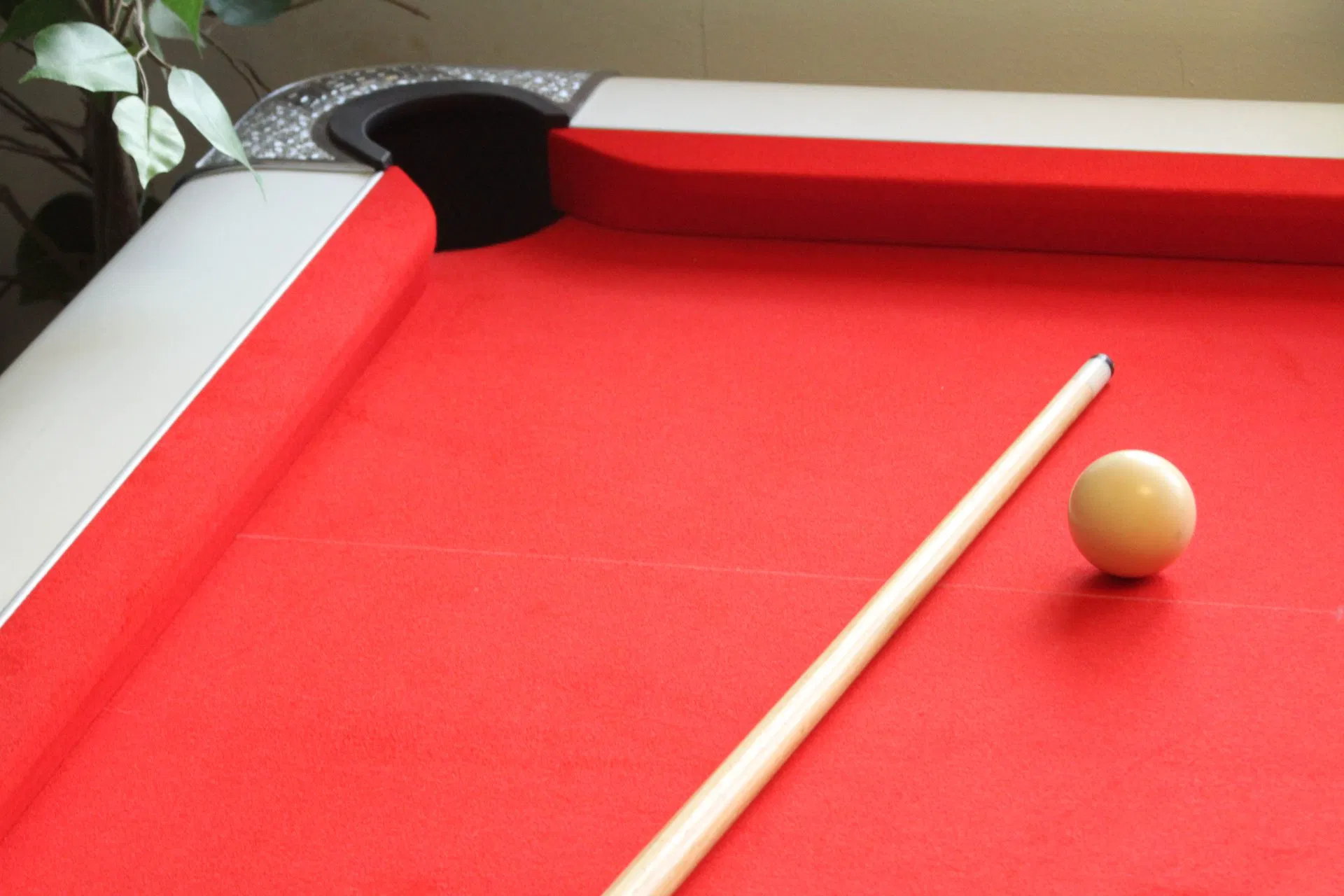
A pool cue spec sheet gives you maybe six numbers, and weight is the only one most players will ever change after buying. It is also the number that matters most on every stroke: the gap between an 18 oz and a 21 oz cue is only three ounces — roughly the mass of half a cue ball — but it is close to a 15% change in the mass you accelerate through the cue ball on every single shot.
Here is what that mass actually does, what the measured physics says about each tier, how to test a weight before you commit to it, and which common beliefs about cue weight do not survive a physics check.
The range, and where the defaults sit
Playing cues commonly run 17–21 oz, and production cues are usually sold in half-ounce steps across 18–21. Nineteen is the industry's default — the most common weight pool cues ship at, the average professionals gravitate toward, and what Dr. Dave Alciatore, whose resource pages are the standard physics reference for the game, calls "a common weight and a good starting point."
For scale: a regulation pool ball weighs 5.5–6 oz under WPA equipment specifications. A 19 oz cue carries more than three times the mass of the ball it strikes — and the whole weight question is about how that mass behaves between your backswing and impact.
What weight changes in the hit: less than you think
The physics is straightforward. For a given cue speed at impact, more cue mass sends the cue ball off faster — but with diminishing returns as weight climbs, and the gains are smaller than most players expect.
Dr. Dave's published analysis (technical proof TP A.30) puts numbers on it: if you could stroke a 22 oz cue at exactly the same speed as a 17 oz cue, the cue ball would leave about 6.3% faster — roughly a 13% gain in effective breaking power. Compare that with simply stroking 10% faster, which yields 10% more cue ball speed and about 21% more breaking power. Cue speed is the far bigger lever.
And that is the catch: the same-speed assumption almost never holds in a real arm. A heavier cue is harder to accelerate, so most players naturally stroke it slower. Whether your personal trade comes out ahead with more mass or more speed is physiology, not physics — which is why the honest answer to "what is the optimal weight" is "the heaviest cue you can still accelerate while staying accurate."
What weight changes in the stroke: the real differences
Where the ounces genuinely show up is between your backswing and impact, not in the collision itself:
- A heavier cue resists deceleration. More mass is harder to slow mid-stroke, which helps players whose stroke tends to quit just before the ball. Some players also keep a heavier cue on its line more easily — Dr. Dave flags this as an individual effect, not a universal one.
- A heavier cue can squirt more. Cue weight often (not always) comes with more shaft endmass, and endmass is what kicks the cue ball off your aim line on sidespin shots. The mechanism is covered in what low-deflection shafts actually do.
- A heavy cue carries a foul risk most players never hear about. More cue mass raises the chance of double hits, pushes or miscues at large tip offsets — and makes a double hit harder to avoid when the cue ball sits a hair away from an object ball, per Dr. Dave's notes.
- A lighter cue is easier to accelerate. Less mass to move means a faster, more compact stroke is available — one reason jump cues run at 12 oz and under, far below any playing cue.
None of these makes a weight "better." They are a trade between stability and speed, priced three ounces at a time.
The three tiers, honestly
19 oz — the default for a reason. Neutral ground: enough mass for a planted, stable stroke, light enough to accelerate for touch shots. If there is no specific reason to choose otherwise, start here. Dr. Dave's advice on weight matches his advice on tip hardness — pick something and stick with it, because consistency compounds faster than spec-shopping pays.
18 oz and under — for speed and touch. A quicker stroke for the same effort, built for a compact, snappy motion rather than a heavy push. This end suits players whose game runs on finesse and soft cue-ball control, smaller or younger players, and anyone crossing over from games that play lighter — snooker cues run roughly 15–19 oz and carom cues 16.5–18.5 oz, over smaller and different-weight balls.
21 oz and up — for stability and effort. More planted through the stroke, and more cue ball speed per unit of effort if your tempo is naturally slow. The price: harder acceleration for delicate shots, plus the squirt and double-hit caveats above. And it will not fix a power problem — the TP A.30 numbers show chasing ball speed through mass alone has a low ceiling.
Misconceptions that refuse to die
"Heavier means more powerful." Only under the assumption your stroke speed stays fixed — the TP A.30 figures above show mass buys far less ball speed than stroke speed does, and a real arm usually swings a heavier cue slower. Power is not printed on the butt.
"Copy the weight your favorite pro uses." Professionals cluster around the same ~19 oz average as everyone else — the spread in our rundown of what weight pool cue the pros use shows there is no secret number. Weight is a physiological fit, not an upgrade tier; cue-buying guides list copying a pro's spec without a fit test among the classic purchasing mistakes.
"Same ounces, same cue." The stamped number is total mass — it says nothing about where that mass sits. Two cues at 19 oz can balance differently and feel unrelated in the hand, which is why a spec sheet is a starting point rather than a verdict. For completeness: Dr. Dave rates balance as a minor factor for most adults — it mainly matters for very short players.
"A lighter cue means better control." Accuracy lives in the stroke, not on the scale — some players hold a heavier cue on line better, not worse. Going light buys a quicker swing and an easier soft game; it does not buy aim.
Break and jump cues are different equipment
Playing-cue logic does not transfer to the break. Maximum cue ball speed is the whole goal, and the optimal break weight depends on arm anatomy, muscle physiology, technique and timing — Dr. Dave's conclusion is that the only way to find yours is to experiment, and some players genuinely break harder with a lighter cue because of the cue speed they gain.
Two levers matter more than the number stamped on the butt. A phenolic tip can add around 17% more breaking power than a medium-hardness leather tip (coefficient of restitution roughly 0.87 versus 0.73 in Dr. Dave's figures), and swing speed beats mass as shown above. If the break cue doubles as a jumper, lighter also makes the legal jump easier. Whether you need a separate break cue at all is a question of its own.
How to test a weight before you buy
The only reliable spec check is your own stroke on the same shots — and one session is enough for a first answer. LeaguePool's version of the test:
- Collect two or three cues at different weights. House cues work fine — most have the weight printed on the butt, and a kitchen or postal scale settles it if not.
- Shoot the same three shots with each cue: a soft lag to the far rail and back, a stop shot from a diamond away, and a medium draw.
- Score each lag by how close you finish to the rail, and note whether the draw had to be forced. The cue that lags tightest without forcing the draw is your starting weight.
Two diagnostics to watch while you shoot, from Billiards Direct's weight guide: if drawing the ball is a struggle, the cue is probably too heavy; if the cue ball feels hard to control or the swing feels like work, it may be too light.
A few ways to run the test honestly:
- Pool halls and shops: house cues come in a spread of weights — Seybert's beginner guide recommends trying them this way. And since many cues carry a weight bolt, asking a repair shop to swap the bolt gives you the same cue at two different weights — the cleanest weight-only comparison available.
- Buying online: favor sellers with a real return policy or a demo program, so the test happens on a table rather than on a spec sheet.
- Control the variables: keep your normal bridge length and grip, change one thing at a time, and give each cue the same handful of warm-up shots before you start scoring.
Then let the results pick the number — not the number you hoped you'd like.
The spec you can change later
Weight is the one number on the sheet that is not permanent. Many cues carry a weight bolt in the butt, and cuemakers commonly offer 1–2 oz discs that can be added or removed — a repair shop can move a cue up or down the range. So the useful question is not "which weight is correct" but "which weight do I calibrate my stroke to." Changing the bolt is cheap; relearning a calibrated stroke is not.
The rest of the spec sheet — tip diameter, shaft material, joints — is covered in our pool cue specs explainer, and our rundown of what weight pool cue the pros use collects where experienced players actually land. For spec browsing across current models, the Cue Database lists the lineup.
The bottom line
Eighteen, nineteen or twenty-one ounces is a calibration choice, not an upgrade tier. Physics gives a heavier cue a small, shrinking edge in cue ball speed at identical stroke speed — and takes most of it back through the stroke speed you lose accelerating it. Start at 19, let your own stroke make the case for moving, and save the deliberation for specs the numbers say matter more.
What weight pool cue do most pros use?
Around 19 oz on average — the same default as everyone else. Individual pros vary, which is exactly why fitting your own stroke beats copying a number.
Is a heavier pool cue more powerful?
Only if you can stroke it at the same speed as a lighter cue. Measured analysis puts five ounces of added weight at roughly +6% cue ball speed, while 10% more stroke speed is worth about +21% break power — speed is the bigger lever.
Can I change a pool cue's weight after buying it?
Usually yes. Many cues carry a removable weight bolt in the butt, and cuemakers commonly offer 1–2 oz weight discs — a cue repair shop can move the cue up or down the range.
What weight should a beginner choose?
19 oz — the industry standard and the most common production weight. Build a repeatable stroke there first, then let your own misses argue for moving up or down.
Sources
- Dr. Dave Alciatore: Cue Optimal Weight — effects of cue weight, and the TP A.30 figures quoted above (TP A.30, cue weight/speed/tip offset vs cue ball speed and spin)
- Dr. Dave Alciatore: Selecting a cue — house-cue checks, comfort-first weight choice, and the consistency-first advice
- Dr. Dave Alciatore: Cue and tip efficiency — COR ranges and the phenolic-tip break-power figure
- LeaguePool — Pool Cue Weight Guide: 18, 19, 20 or 21 oz? — the one-session weight test protocol and typical weights by cue type
- Seybert's — How to Choose a Cue Stick for Beginners — testing house cues, try-before-you-buy, return policies and demo programs
- Ariakon — Ten Pool Cue Buying Mistakes and How to Check for Them — copying a pro's spec, same weight but different balance, testing weight as a controlled variable
- Wikipedia: Cue stick — weight ranges for pool, snooker, carom and jump cues; weight discs; pro average
- Wikipedia: Billiard ball — WPA equipment spec, 5.5–6 oz at 57 mm
- Billiards Direct — How to choose a pool cue weight — half-ounce production steps, weight bolts, and the too-heavy/too-light diagnostics
More coverage
Keep reading
Sneaky Pete Cue Explained: The House Cue That Isn't
A Sneaky Pete is a quality two-piece cue built to look like a cheap bar cue — plain outside, serious inside. The history, the tells, and what they cost.
Pool Cue Wood Types: Maple, Ash, and What the Exotics Do
Maple rules the shaft, ash owns snooker, and ebony, cocobolo and rosewood dress the butt. What cue woods actually change — and what is decoration.
Pool Table Cloth Compared: Simonis vs Gorina vs Andy
Walk into any forum thread about reclothing an American pool table and the same three names surface within minutes: Simonis, Gorina and Andy. All three make…