Viking CRUSH vs Pure X HXT: Is Five-in-One Worth It?
At $420 and $429, this isn't a price fight. It is a choice between fewer parts and far more ways to configure a jump shot.
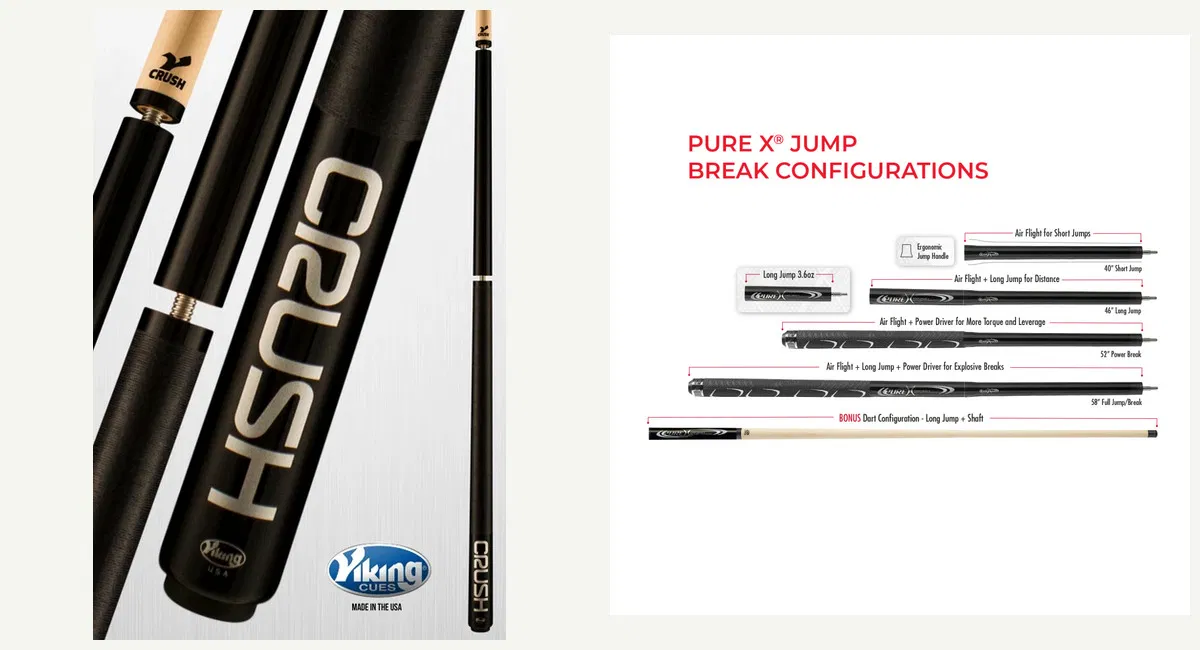
The Viking CRUSH 3-Piece is the cleaner choice for players who want a familiar maple break/jump cue with fewer parts, while the Pure X HXT 5-in-1 is the better tool for players who actually change jump technique and cue length from shot to shot. Their list prices are only $9 apart, so this decision has little to do with budget. It comes down to one question: do you want a simple three-piece specialist or a modular system with five usable configurations?
The Viking costs $420 and publishes unusually specific construction details, including a Hard Rock Michigan Maple shaft, phenolic tip and ferrule, 5/16 x 18 quick-release pin, Irish linen wrap, and lifetime warranty. The Pure X lists at $429 and counters with four quick-release joints, a 35.5-to-58-inch working range, an MZ traction grip, and several ways to build the cue for short jumps, long jumps, leverage shots, and breaks.
What changes when only $9 separates the two cues?
Almost everything except the price.
Viking treats the CRUSH as a conventional cue that can split into a shorter jump setup. The design remains recognizable: maple shaft, maple forearm, linen wrap, phenolic hardware, and a steel pin. There is less to remember when a match turns awkward. Unscrew the rear section, set the bridge, and play the jump.
Pure X treats the HXT as a kit. The shaft, Air Flight jump handle, Long Jump extender, and wrapped Power Driver section can be combined in different ways. That gives the player several balance points and grip positions rather than one standard jump-cue layout.
This is why comparing the two by price alone misses the point. Viking sells a straightforward cue with strong documentation. Pure X sells options.
How do the verified specifications compare?
| Specification | Viking CRUSH 3-Piece | Pure X HXT 5-in-1 |
|---|---|---|
| Current list price | $420 | $429 |
| Promotional price seen | No current discount confirmed | From $343.20 on selected store listings |
| Basic design | Three-piece break/jump cue | Four joints, five configurations |
| Shaft | V CRUSH Hard Rock Michigan Maple | Pure X Break shaft |
| Shaft technology | Traditional maple construction | Carbon Fiber Impact System |
| Taper | Conical CRUSH | Not stated on product page |
| Tip | Viking Phenolic | XLG Quad Face extra-hard |
| Ferrule | Reactive Black Phenolic | Not stated |
| Main joint | Flat-faced modified acrylic with brass insert | Quick release; thread standard not stated |
| Pin | Stainless steel Viking 5/16 x 18 quick release | Not stated |
| Grip | Black Irish linen | Three-zone MZ Grip |
| Working lengths | Full assembled length not stated | About 35.5 to 58 inches |
| Forearm | Aged Hard Rock Michigan Maple | Material not stated |
| Finish | Three-coat UV urethane | Not stated |
| Manufacturing | Made in USA | Origin not stated |
| Warranty shown | Lifetime, including warpage | Model-specific terms not shown on product page |
These are manufacturer and official store specifications reviewed on October 18, 2026. Neither page publishes a complete finished-weight range, and the selectable tip sizes shown by the stores aren't exposed clearly enough in the page text to quote as confirmed options.
Why does the Viking CRUSH feel like the safer traditional choice?
The CRUSH gives a buyer more information before checkout. Viking identifies the shaft wood, taper, tip, ferrule, wrap, forearm, finish, joint face, insert, pin, butt plate, bumper, and warranty. That doesn't prove better performance, but it removes a lot of guesswork.
Its build also follows a familiar break-cue recipe. A conical maple shaft resists flex differently from a playing shaft with a long pro taper. The phenolic tip and phenolic ferrule create a hard front end intended for impact rather than touch. Players coming from older dedicated breakers should recognize the basic idea immediately.
The black Irish linen wrap is another dividing line. Linen gives the rear hand a dry, textured surface without the molded ridges of the Pure X grip. Some players want that quieter, conventional contact. Others would rather feel a more aggressive traction pattern during the break stroke.
Viking's three-piece format also reduces the number of connections that must stay clean and tight. That matters in a crowded league case. There are fewer sections to misplace, fewer joint faces to inspect, and fewer setup choices to make while the shot clock is moving.
What do the five Pure X configurations actually add?
They add useful length changes, not just marketing arithmetic.
The official Pure X material shows a shortest dart-style setup around 35.5 inches and a fully assembled jump/break cue at 58 inches. Between those points, the player can combine the Air Flight handle, Long Jump extender, Power Driver grip section, and shaft for different tasks.
The shorter assemblies favor steep, compact strokes when the cue ball must clear a close blocker. Longer combinations provide more reach and leverage. The full build becomes the break cue. The MZ Grip places different traction zones along the wrapped section, so the rear hand can move without landing on one uniform surface.
That flexibility has real value for a player who uses more than one jump technique. A dart stroke over a close ball and a longer pendulum stroke from farther away don't ask the same thing from the cue. Pure X lets the equipment change with the shot.
There is a tradeoff. Four quick-release joints mean more hardware to assemble, carry, and check. The cue won't choose the correct configuration for you, either. A player who rarely jumps may own five setups and use only one.
Which cue has the more convincing break setup?
The published specifications don't support a winner on power.
Viking pairs its conical maple shaft with a phenolic tip and ferrule. That is a direct, rigid package, and the linen grip gives the player a stable reference point for the rear hand. The CRUSH also avoids the feeling of a multi-extension tool when fully assembled. On paper, it looks like a break cue first and a jump cue second.
Pure X uses an extra-hard XLG Quad Face tip, a reinforced Pure X Break shaft, and the longest 58-inch configuration for breaks. The Power Driver grip section is specifically intended to add leverage. The HXT therefore approaches the break through modular mechanics rather than a simpler wood-cue layout.
No verified head-to-head test publishes cue-ball speed, rack spread, energy transfer, or break consistency for these exact retail models. A hard tip by itself doesn't settle the question. Stroke delivery, cue weight, shaft stiffness, contact height, and rack quality all influence the result.
The honest split is practical: Viking is easier to understand as a dedicated breaker, while Pure X asks the buyer to value its jump range as part of the break-cue price.
Which one is the smarter jump cue?
Pure X wins on range. Viking wins on speed of setup.
The HXT can become a compact dart cue, two longer jump arrangements, a leverage-oriented build, and a full jump/break cue. That gives serious jump-shot users room to match cue length to obstacle distance and stroke style. If a player already knows why a 35.5-inch setup behaves differently from a 46- or 52-inch setup, the hardware won't sit idle.
The CRUSH has fewer decisions. Its conventional three-piece layout covers the central job without turning the case into a parts tray. For league players who attempt a jump only occasionally, that can be the stronger design. Less adjustment means more attention stays on elevation, tip placement, and landing distance.
Versatility is useful only when it gets used. That sentence decides this category.
Is the Pure X shaft made entirely from carbon fiber?
The official description doesn't establish that.
Cue & Case calls the feature a Carbon Fiber Impact System and says it increases stiffness and strength. The page still names the component a Pure X Break shaft rather than a full-carbon shaft, and it doesn't provide a complete material breakdown. Buyers shouldn't translate a reinforcement system into a claim that the entire shaft is carbon fiber.
This distinction matters because full-carbon construction affects maintenance expectations, sound, surface finish, and price. A reinforced wood or composite shaft may still be durable and effective, but it belongs in a different technical category until the maker confirms otherwise.
Viking is clearer here. Its V CRUSH shaft is listed as Hard Rock Maple. There is no ambiguity about the primary material.
Which joint system is easier to own long term?
Viking publishes the more useful information. The CRUSH uses a stainless steel 5/16 x 18 quick-release pin, a flat-faced modified acrylic joint, and a brass insert. A buyer can describe that hardware accurately when ordering service or discussing a replacement.
Pure X confirms four quick-release joints but doesn't state the thread standard on the current product page. Those joints are central to the HXT's appeal, yet the missing dimension makes outside compatibility hard to judge.
There is no verified basis for assuming that shafts, jump handles, or extensions from the two systems can be mixed. Even matching thread labels wouldn't guarantee clean collar alignment or correct joint depth. Treat each cue as its own closed assembly unless the manufacturer confirms a specific pairing.
Does the Pure X sale price change the result?
It can.
The standard product listing shows $429, but Cue & Case collection and selected-variant pages have displayed pricing from $343.20. That is a $85.80 reduction from list price and $76.80 below the Viking. At that checkout price, the HXT becomes much easier to recommend to a player who wants multiple jump configurations.
The word “from” matters. Color, joint, tip size, stock, and promotion rules can change the final amount. Buyers should select the exact variant and confirm the cart total rather than treating $343.20 as a universal price.
At full list price, the $9 gap is irrelevant. At the observed promotional price, Pure X has a clear cost advantage. Viking answers with its published lifetime warranty, USA manufacture, and more complete material disclosure.
What could frustrate an owner after purchase?
For the CRUSH, the frustration is limited specification depth in a few practical areas. Viking's page doesn't clearly publish the fully assembled length, the available finished weights in static text, or the exact tip-diameter menu. Those choices appear in selectors, so a buyer should confirm the selected configuration before paying.
The CRUSH is also less adaptable. A player who later develops several jump strokes may want more length choices than its three-piece layout provides.
For the HXT, complexity is the obvious cost. Four joints create more surfaces to keep clean and more pieces to track. The product page also leaves out the shaft taper, ferrule material, exact joint threads, finished weights, manufacturing origin, and model-specific warranty terms.
None of those gaps makes the HXT a poor cue. They simply mean that a detail-focused buyer may need to contact Cue & Case before ordering.
Who should buy the Viking CRUSH?
Choose the Viking if you:
- Want a jump/break cue that behaves like a conventional cue first.
- Prefer a maple shaft and conical taper.
- Like the dry texture of Irish linen.
- Want fewer pieces and faster assembly.
- Care about a published lifetime warranty that includes warpage.
- Value USA manufacture and detailed component information.
The CRUSH is especially sensible for a player who breaks frequently but jumps only when the layout demands it. Its strongest feature is focus, not novelty.
Who should buy the Pure X HXT 5-in-1?
Choose the Pure X if you:
- Use both dart and longer jump strokes.
- Want cue lengths from roughly 35.5 to 58 inches.
- Prefer a molded, multi-zone traction grip.
- Don't mind carrying and assembling extra sections.
- Want one case slot to cover several jump-cue roles.
- Can secure the desired variant at the promotional price.
The HXT makes the most sense for the player who can name the situations in which each configuration will be used. If all five setups sound interesting but none solves a current problem, the Viking's simplicity is probably worth more.
What is the final verdict?
Buy the Viking CRUSH for a dependable, traditional break-first package. Buy the Pure X HXT 5-in-1 for genuinely broader jump-shot configuration.
At $420 versus $429, the Viking is our default recommendation. It publishes more of the specifications that affect ownership, uses familiar materials, carries a strong stated warranty, and keeps the operating routine simple.
The Pure X becomes the better purchase in two cases. First, you already switch between short dart jumps and longer jump strokes. Second, the exact color and configuration you want is available near the observed $343.20 promotional price. Then the extra joints deliver both flexibility and meaningful savings.
Don't buy by the number in the product name. Buy by the number of configurations you'll actually use.
Is the Viking CRUSH a break cue and a jump cue?
Yes. It is a three-piece break/jump cue that converts from its full breaking setup into a shorter jump configuration.
How many setups does the Pure X HXT 5-in-1 provide?
Pure X advertises five jump and break configurations using four quick-release joints, with working lengths from about 35.5 to 58 inches.
Is the Pure X HXT shaft fully carbon fiber?
The official page confirms a Carbon Fiber Impact System but does not identify the entire shaft as solid carbon fiber. Buyers seeking a full-carbon shaft should ask the manufacturer for the material construction.
Which cue has the better warranty?
Viking clearly states a lifetime warranty, including warpage. The Pure X product page does not show model-specific warranty terms, so the comparison is incomplete until Cue & Case confirms coverage.
Can Viking and Pure X sections be used together?
There is no verified cross-brand compatibility. The joint specifications are not documented closely enough to assume that either brand's shaft, handle, or extension will fit the other.
More coverage
Keep reading
McDermott VQ1 vs Becue WAS: Carbon Feel or Wood Skin?
McDermott VQ1 offers integrated balance control and clearer shaft options. Becue WAS wraps carbon in real wood at a lower euro list price.
Predator Air Rush vs Cuetec Propel: What Does $30 Buy?
Predator Air Rush costs $30 more and publishes two complete configurations. Cuetec Propel answers with an 11 oz all-composite build and lower MSRP.
Tiger IMPAKT vs Pechauer Rogue Break: Is $150 Extra Worth It?
Tiger IMPAKT offers a complete carbon break cue from $950. Pechauer's Rogue-equipped breaker costs $800 and provides broader joint choices.