Richard Black Four Point vs Tascarella Standard Basic
One maker publishes the price; the other publishes the build. Here is what each order leaves you to confirm.
The Richard Black Four Point is the clearer choice for buyers who need a published starting price, while the Tascarella Standard Basic is easier to evaluate as a technical build. Richard Black lists its cue at $2,000 but leaves several playing specifications unstated. Tascarella names the length, joint, pin, ferrule, tip and major woods, yet requires the buyer to request a price.
That makes this less of a contest between two finished retail products and more of an order-risk audit. Both are traditional four-point custom pool cues with two shafts and linen wraps. The practical question is which uncertainty you would rather resolve before paying a deposit: configuration or final cost.
What exactly is being compared?
These cues occupy the same broad design category. Each is a custom playing cue built around four points, four veneers, two shafts and a linen-wrapped handle. Neither is a mass-produced SKU with one fixed inventory configuration.
Richard Black describes the Four Point as a traditional design with four colored veneers. Ebony is typical, but another exotic hardwood can be specified. The listed price is $2,000.
Tascarella describes the Standard Basic as a 58-inch short-splice cue, normally divided into equal halves. Its published baseline includes a piloted stainless-steel joint, a 5/16x14 stainless-steel screw, Juma ferrules and LePro tips.
This distinction matters. A custom-cue page describes the starting recipe, not every detail of the cue that will arrive months later. Any material change should be priced and recorded in the order before the deposit is sent.

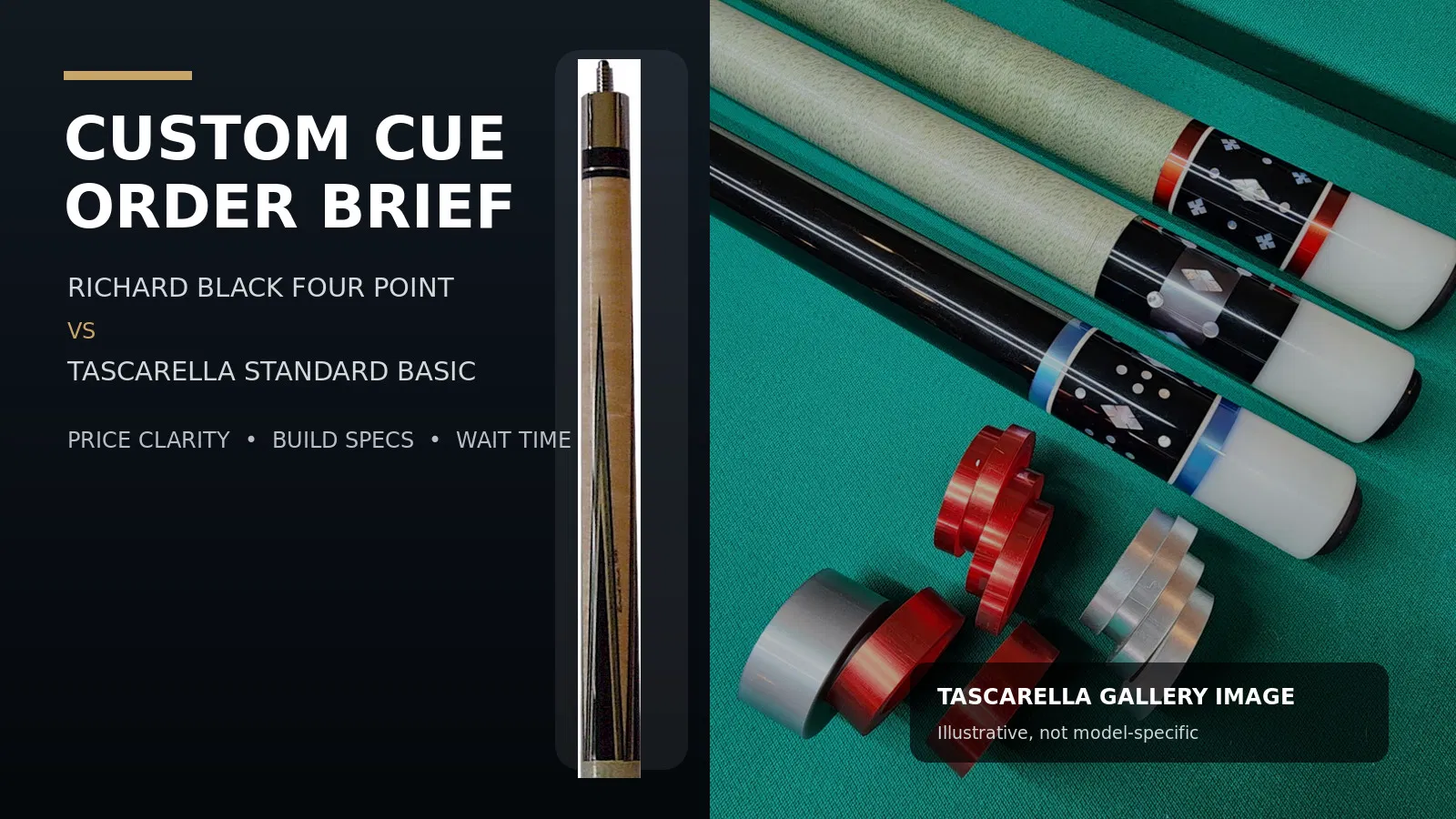
Richard Black's official Four Point image. The maker publishes a design description and starting price, but not a complete playing specification.
How do the published specifications compare?
| Specification | Richard Black Four Point | Tascarella Standard Basic |
|---|---|---|
| Cue type | Custom pool playing cue | Custom pool playing cue |
| Construction style | Traditional four-point design | Traditional short-splice design |
| Points and veneers | Four points, four colored veneers | Four points, four veneers |
| Forearm / main woods | Usually ebony; other exotic hardwoods available | Straight, birdseye or curly maple forearm; rosewood or ebony center |
| Shafts included | Two | Two |
| Shaft material | Not stated on the product page | Not clearly stated in the core specification |
| Ferrules | Ivory where permitted; Aegis for cues shipped outside the USA | 1-inch Juma |
| Tips | Not stated | Medium/hard LePro with fiber backing |
| Tip diameter | Not stated | Not stated |
| Joint | Not stated | Piloted stainless steel, compression style |
| Joint screw | Not stated | Stainless-steel 5/16x14 |
| Length | Not stated | 58 inches, equal halves unless requested otherwise |
| Weight / balance | Not stated | Not stated |
| Wrap | Linen | Irish linen |
| Butt cap / bumper | Not stated | White Delrin / brown rubber |
| Published price | $2,000 starting configuration | Quote required |
| Deposit | 25%, non-refundable | 20% |
| Published wait time | Not stated | Approximately 18 months |
| Current order status | Maker is producing fewer than 20 cues per year | New orders accepted |
The table shows why a price-only comparison would be misleading. The Richard Black figure is public, but the page does not state the joint, pin, tip, taper, finished length or target weight. Tascarella gives a much fuller baseline, but the amount due cannot be compared until a quote is issued.
Which order has the clearer cost?
Richard Black wins on initial price visibility. The Four Point is listed at $2,000, and the maker's home page says custom pool cues start at that level. That number should still be treated as a base price. An alternate hardwood, material substitution or design request may change the quote.
The required deposit is 25% and non-refundable. Applied to the published $2,000 starting price, that would be $500. The actual deposit should be calculated from the written quote, not assumed from the catalog figure.
Tascarella publishes no Standard Basic price. The customer emails the shop, answers configuration questions and receives an estimate. A 20% deposit then secures the order. A lower deposit percentage does not prove a lower cash commitment because the total price is unknown.
For budget control, ask both makers for the same four lines in writing: base price, selected-option charges, shipping, and the conditions under which the final amount can change. Without that record, the two deposit percentages say little about total financial exposure.
Which maker gives the better technical baseline?
Tascarella provides the stronger pre-order specification. A buyer can see that the standard cue is 58 inches, uses a piloted stainless-steel joint and a 5/16x14 screw, and comes with 1-inch Juma ferrules and medium/hard LePro tips. The page also identifies the collar treatment, forearm choices, center woods, butt sleeve, butt cap and bumper.
Richard Black provides the design concept and the materials included across its Traditional Cues line: two shafts, linen wrap, cap protectors and a felt shipping bag. The Four Point may use ebony or another exotic hardwood. However, several items that affect fit and playing preference are not published.
That gap is not evidence of lower quality. It means the buyer has more work to do before ordering. Weight, balance point, shaft diameter, taper, tip, joint construction and finished length should be confirmed rather than inferred from photographs or other Richard Black cues.
Do the ferrule policies matter for an international order?
Yes. Richard Black states that Traditional Cues normally receive ivory ferrules, while cues sent outside the United States receive Aegis ferrules. It also says cues with ivory inlays cannot be shipped out of the country, although substitute materials may be possible.
An overseas Four Point can therefore differ materially from a domestic example. The buyer should request the exact ferrule and inlay materials on the invoice and check import rules in the destination country before approving the design.
Tascarella's published Standard Basic uses 1-inch Juma ferrules. This removes one material variable from the baseline order, though any requested change still needs written confirmation.
Ferrule material alone cannot predict feel, deflection or durability in a completed cue. Those outcomes also depend on shaft geometry, wood, tip, assembly and the player's stroke. Neither maker publishes a controlled head-to-head test for these two builds.
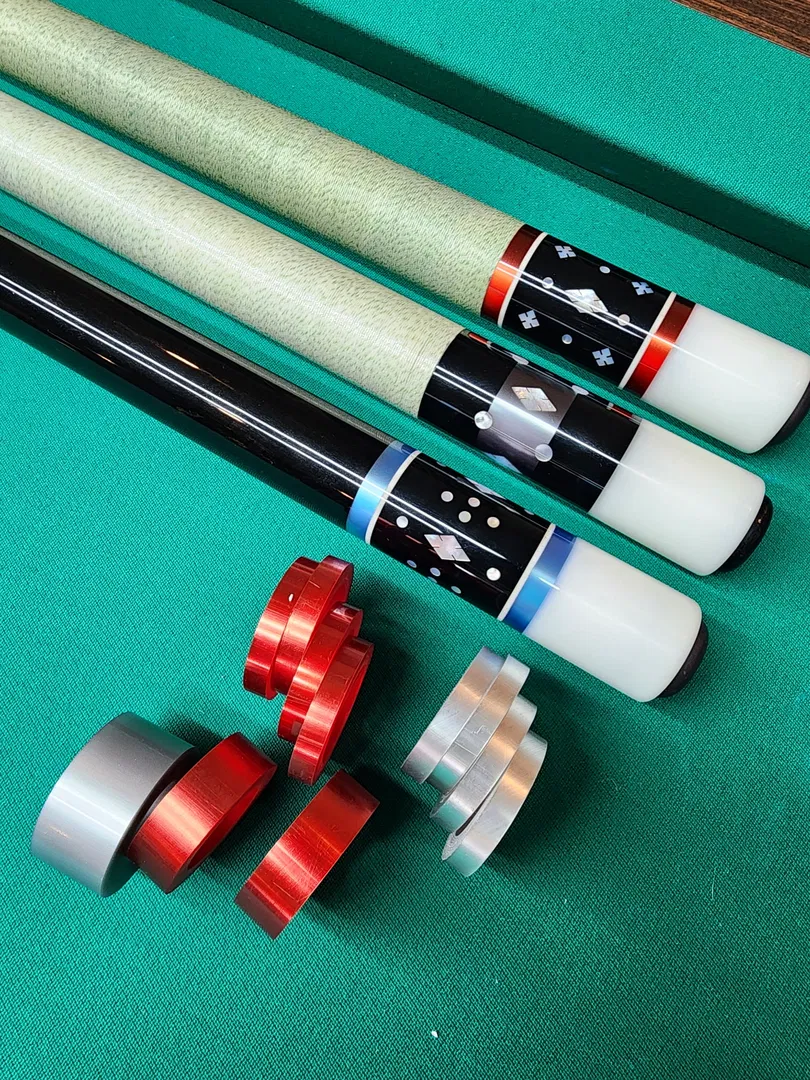
An official Tascarella gallery image illustrating the shop's custom work. It is not identified by the maker as the exact Standard Basic configuration.
Can shafts be swapped just because one cue uses 5/16x14?
No. Tascarella confirms a 5/16x14 stainless-steel joint screw, but thread designation is only one part of the fit. A replacement shaft must also match the pilot, joint face, collar diameter, thread depth and machining tolerances.
Richard Black does not publish the Four Point joint specification on the catalog page. Buyers should not assume it uses the same joint as another cue from the maker or as a cue seen on the secondary market.
For either cue, send the maker the butt when ordering an additional shaft if that is their preferred fitting process. At minimum, obtain written confirmation that the new shaft will be cut and faced for the exact butt. A nominal pin match is not a compatibility guarantee.
What does the wait time really tell a buyer?
Tascarella says it is accepting orders with a current wait of approximately 18 months. That is a planning estimate, not a delivery guarantee. Material selection, design revisions and workload may affect the schedule, so the quote should state how timing updates will be communicated.
Richard Black does not publish a wait time. The maker says he works alone and produces just under 20 cues per year. That signals limited production capacity, but it does not reveal the queue for a new Four Point order. Production volume should not be converted into a delivery estimate without asking the shop.
Scarcity also does not guarantee resale appreciation. A cue's secondary-market result depends on condition, provenance, design, current demand and the buyer pool. The published production rate and the Tascarella queue are useful ordering signals, not investment forecasts.
Who should choose the Richard Black Four Point?
The Richard Black is the more logical starting point if you want a visible budget floor, prefer direct material discussion with a low-volume maker, and value the option to choose ebony or another exotic hardwood. The official $2,000 figure lets you decide whether the conversation belongs within your budget before contacting the shop.
It also suits a buyer who is comfortable defining specifications actively. Before paying the 25% deposit, that buyer should secure a written build sheet covering joint, finished length, weight range, balance target, shaft diameter, taper, tip, ferrule material and all international substitutions.
Do not choose it solely because fewer than 20 cues are made annually. Limited output may add personal or collecting appeal, but it does not establish superior play or future value.
Who should choose the Tascarella Standard Basic?
The Tascarella is the easier order to frame if you want a traditional 58-inch short-splice build and already like the idea of a piloted stainless-steel 5/16x14 joint. Its baseline answers more technical questions before the first email.
It also fits a buyer who prefers known component choices such as Juma ferrules, LePro medium/hard tips and Irish linen. The trade-off is a quote-only price and an approximately 18-month published wait.
Ask the shop to add weight, balance, tip diameter, shaft taper and shaft wood specification to the quote. Those details remain important even when the catalog description is comparatively complete.
What should be confirmed before either deposit?
Use the order discussion as a six-part checkpoint:
- Finished dimensions: overall length, butt length, shaft length and tip diameter.
- Playing setup: target weight, acceptable tolerance, balance point and taper.
- Joint fit: pin, pilot, joint-face material, collar diameter and extra-shaft fitting.
- Materials: shaft wood, ferrule, tip, forearm, handle, points, veneers and inlays.
- Commercial terms: final price, option charges, deposit status, shipping and taxes.
- Schedule and service: estimated completion, update process, warranty and post-delivery adjustment policy.
A clear build sheet protects both sides. It also prevents a catalog-level statement, such as “two shafts” or “5/16x14,” from being mistaken for a fully specified order.
Which custom cue is the better buy?
There is no verified price basis for declaring an overall value winner because Tascarella does not publish the Standard Basic price. There is also no controlled playing test showing that either cue is more accurate, lower in deflection or better at transferring energy.
The defensible decision is narrower. Choose Richard Black for published starting-price clarity and greater stated wood flexibility. Choose Tascarella for a more complete standard specification and a disclosed current queue.
The best buy will be the cue whose final written configuration matches your preferences at a price and wait you accept. Until both quotes contain the same dimensions and components, comparing only $2,000 with an unknown price would create false precision.
How much does the Richard Black Four Point cost?
Richard Black lists the Four Point at $2,000. Treat this as the published starting price because wood, materials and custom design requests may change the final quote.
How much does the Tascarella Standard Basic cost?
Tascarella does not publish a price for the Standard Basic. The shop asks buyers to discuss the configuration and then provides an estimated price.
How long is the wait for a Tascarella custom cue?
The official new-orders page currently states an approximate 18-month wait. It is an estimate and should be reconfirmed when the order is placed.
Does the Richard Black Four Point include two shafts?
Yes. Richard Black says its Traditional Cues include two shafts, linen wrap, cap protectors and a felt shipping bag. The Four Point page does not publish the shaft diameter, taper or tip.
Will any 5/16x14 shaft fit the Tascarella Standard Basic?
Not necessarily. The Tascarella uses a piloted 5/16x14 stainless-steel joint, but pilot dimensions, collar diameter, joint face and machining tolerances must also match.
More coverage
Keep reading
Viking eX101 vs Pure X HXTC14: The Better $351 Cue?
At nearly the same price, Viking’s eX101 and Pure X’s HXTC14 split on shaft detail, joint, grip and sale pricing. See which setup fits your game.
Valhalla VA112 vs Lucky L65: The Better First Pool Cue?
Compare the $150 Valhalla VA112 and $235 Lucky L65 on maple construction, joints, warranty, shaft upgrades, and first-cue value.
Schmelke JB11 vs McDermott SH1: Is $345 More Worth It?
Schmelke's $180 JB11 and McDermott's $525 SH1 share 13.25 mm tips and 3/8x10 joints. See what the $345 price gap really buys.