How Long Is a Pool Cue? The 58-Inch Standard, Explained
Why 58 inches became the default, who actually needs longer or shorter, and the cheaper ways to change length without changing cues.
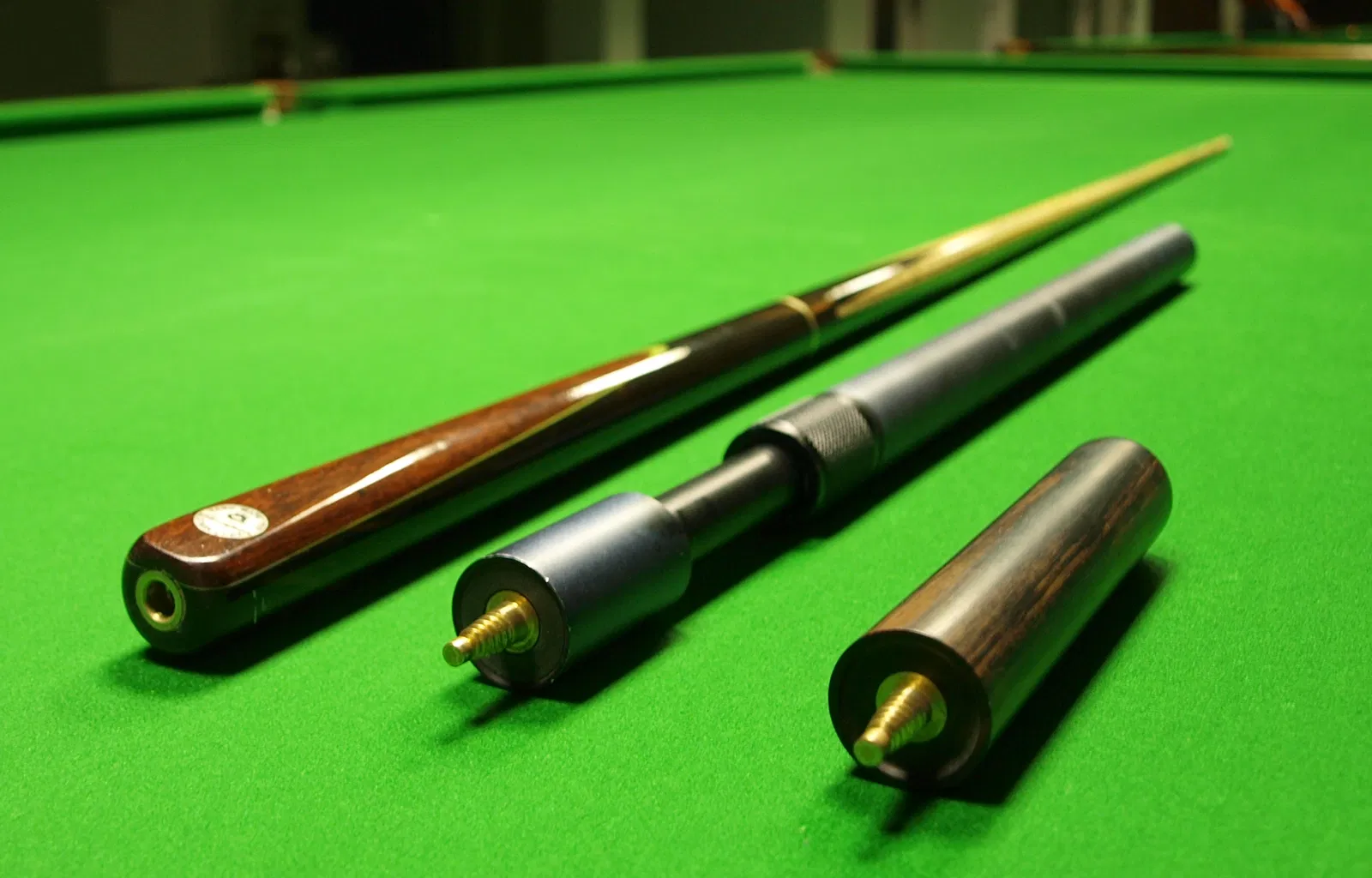
Ask for a pool cue almost anywhere in the world and you will be handed about 58 inches of tapered maple. That number is so standardized that most spec sheets do not even bother explaining it — but the question of cue length is really three questions: why 58 became the default, when a different length actually fits better, and what to do when the cue in your hands is the wrong size for you or your room.
The standard: 58 inches
Nearly every production playing cue ships at about 58 inches, and spec sheets across the industry cluster in a 57–59 inch band (Wikipedia's cue stick entry puts the pool-cue average around 59). It was not always so: according to cuemaker Tom Simpson, whose cue-length notes are published by PoolDawg and cited by Dr. Dave, pool cues ran 57 inches until somewhere in the 1960s — players were simply shorter on average, and the standard moved to 58 inches as they grew.
Why that length at all? Geometry. At address, your forearm should hang perpendicular to the cue, as Dr. Dave's cue-length FAQ puts it — and 58 inches is the length that gives most adults that position with a normal stance and a normal bridge. It is also long enough to reach across a nine-foot table for the large majority of shots without fetching the mechanical bridge.
When you genuinely need longer
Simpson's rule of thumb: players around 6'4" and taller really do need a longer cue, and players with very long arms, very broad shoulders or an unusually long bridge sometimes qualify too. The tell is simple — if you regularly find your grip hand running out of cue and bumping into the bumper, the cue is too short for you. Some shorter players also choose a longer cue on purpose, trading feel for the reach to avoid the mechanical bridge.
Two warnings before ordering extra inches:
- Length changes the cue, not just the tape measure. A longer cue moves the balance point toward the butt and gets heavier — and Simpson notes that even a half-inch shift in balance changes how a cue feels. His advice: if you are going longer, add a few inches; anything beyond about six inches is probably too much.
- Your case may stop fitting. Non-standard cues do not always fit standard cases — a detail worth checking before you spend the money.
For perspective on the far end: Simpson points out that Earl Strickland and Shane Van Boening — both tall players who sometimes compete on ten-foot tables — play custom cues 8–12 inches longer than standard. That is a pro solution to a pro problem, not a template for a league night.
The flexible answer: extensions
You do not have to commit to a longer cue to get a longer cue. Two kinds of extension exist, and they are not interchangeable:
- Butt (bumper) extensions screw into the end of the butt and come on and off during play in seconds — the easier option for occasional reach.
- Joint extensions fit between the shaft and the butt. They change the cue's balance differently, and Dr. Dave flags a subtle downside: a joint extension can sometimes introduce a slight warp.
Snooker figured this out decades ago — a typical snooker cue runs 57–58 inches and ships with detachable butt extensions adding six inches or more, which is how players reach across a twelve-foot table. Either way, an extension is a cheaper experiment than a custom-length cue.
When shorter is the right answer
Small rooms. The room-sizing math most retailers use: take the playing area, add a cue length (58 inches) plus about six inches of backswing clearance on every side. If your room does not make the number, the usual fix is a shorter cue kept for the tight side — dealers stock one-piece "shortie" cues at 36, 42, 48 and 52 inches for exactly this problem. Dr. Dave's table-size FAQ is blunt about the tradeoff, though: many players end up unhappy relying on short cues full-time, so it is worth testing the real layout before buying a table that needs them.
Kids. Children's cues are sized to height, not age alone — one manufacturer's youth guide (Players) pairs roughly a 36-inch cue with players under four feet tall, 48 inches up to about 4'3", 52 inches up to about 4'9", and a full 57–58 inch cue after that.
Jump shots. Jump cues are a different tool entirely — around 40 inches, built short so the near-vertical jump stroke is possible at all. Whether a separate jump cue is worth carrying is its own question; break cue vs playing cue covers the dedicated-cue logic.
Other games, other lengths
The 58-inch answer is a pool answer. Snooker cues run 57–58 inches with the extension system above; carom cues sit toward the shorter end of the range. And if you ever wondered whether there is a legal minimum: in snooker and English billiards there is — the rules require a cue no less than three feet (914 mm) long, a clause dating to 1938 after a player at Thurston's Hall pulled a fountain-pen-sized cue from his waistcoat pocket, chalked it and played a stroke mid-match. The referee ruled it not a cue; the rulebook has said so ever since. Pool has no equivalent law — the 58 inches is convention and geometry, not legislation.
How to check your own fit
The test costs nothing and needs no tape measure. Take your normal address position on a shot: if your grip arm hangs comfortably perpendicular to the cue with hand room to spare at the bumper, the length fits. If you are crowded against the bumper, first try a shorter bridge — if that is already as short as your game allows, you are a candidate for a longer cue or an extension. And remember the half-inch rule: balance moves with length, so borrow a longer cue or try an extension for a session before ordering a custom.
Length is one line on the spec sheet alongside weight, tip diameter and shaft material — the rest of that sheet is decoded in our pool cue specs explainer, and the weight side of the fit question has its own guide: how to choose a pool cue weight. If you are browsing what lengths current models actually ship at, the Cue Database lists the specs.
What is the standard length of a pool cue?
About 58 inches — production cues almost all cluster in a 57–59 inch band. The older standard was 57 inches; it crept up around the 1960s as players got taller.
Do tall players need a longer cue?
Roughly 6'4" and up, yes — and also players with very long arms or a very long bridge. The tell is your grip hand running out of cue at the bumper. For occasional reach, a screw-on extension is cheaper than a longer cue.
Is a longer pool cue better?
Only when it fits. Extra length buys reach but moves the balance point toward the butt and adds weight — even a half-inch changes the feel. Most fitting advice caps the useful gain around six inches.
What length cue should a child use?
Size to height: roughly a 36-inch cue under four feet tall, 48 inches to about 4'3", 52 inches to about 4'9", then a full 57–58 inch cue.
Sources
- Dr. Dave Alciatore: Cue Length — the forearm-perpendicular fit rule, who needs a longer cue, joint vs butt extensions, and the Tom Simpson notes quoted above
- Dr. Dave Alciatore: Table and room sizes — the playing-area + cue-length + clearance formula, and the short-cue caveat
- PoolDawg Academy — Does Pool Cue Length Really Matter? — the 57-inch to 58-inch history, balance-point effects, the six-inch ceiling and the Strickland/Van Boening custom lengths
- Wikipedia: Cue stick — the 57–59 inch range, snooker cue lengths and extensions, carom cues, and the three-foot minimum rule with the 1938 fountain-pen incident
- Dr. Dave Alciatore: Cue tapers — jump cue dimensions (~40 inches)
- Billiard Factory — Players Shortie Cues — 36/42/48/52-inch short cue options (dealer listing)
- Players Y-B02 youth cue listing (Amazon) — the manufacturer youth sizing guide pairing cue lengths to player height
More coverage
Keep reading
Sneaky Pete Cue Explained: The House Cue That Isn't
A Sneaky Pete is a quality two-piece cue built to look like a cheap bar cue — plain outside, serious inside. The history, the tells, and what they cost.
Pool Cue Wood Types: Maple, Ash, and What the Exotics Do
Maple rules the shaft, ash owns snooker, and ebony, cocobolo and rosewood dress the butt. What cue woods actually change — and what is decoration.
Pool Table Cloth Compared: Simonis vs Gorina vs Andy
Walk into any forum thread about reclothing an American pool table and the same three names surface within minutes: Simonis, Gorina and Andy. All three make…