Schmelke JB11 vs McDermott SH1: Is $345 More Worth It?
One break cue sells on purpleheart simplicity and selectable weight; the other on patented phenolic hardware and a textured sport grip.
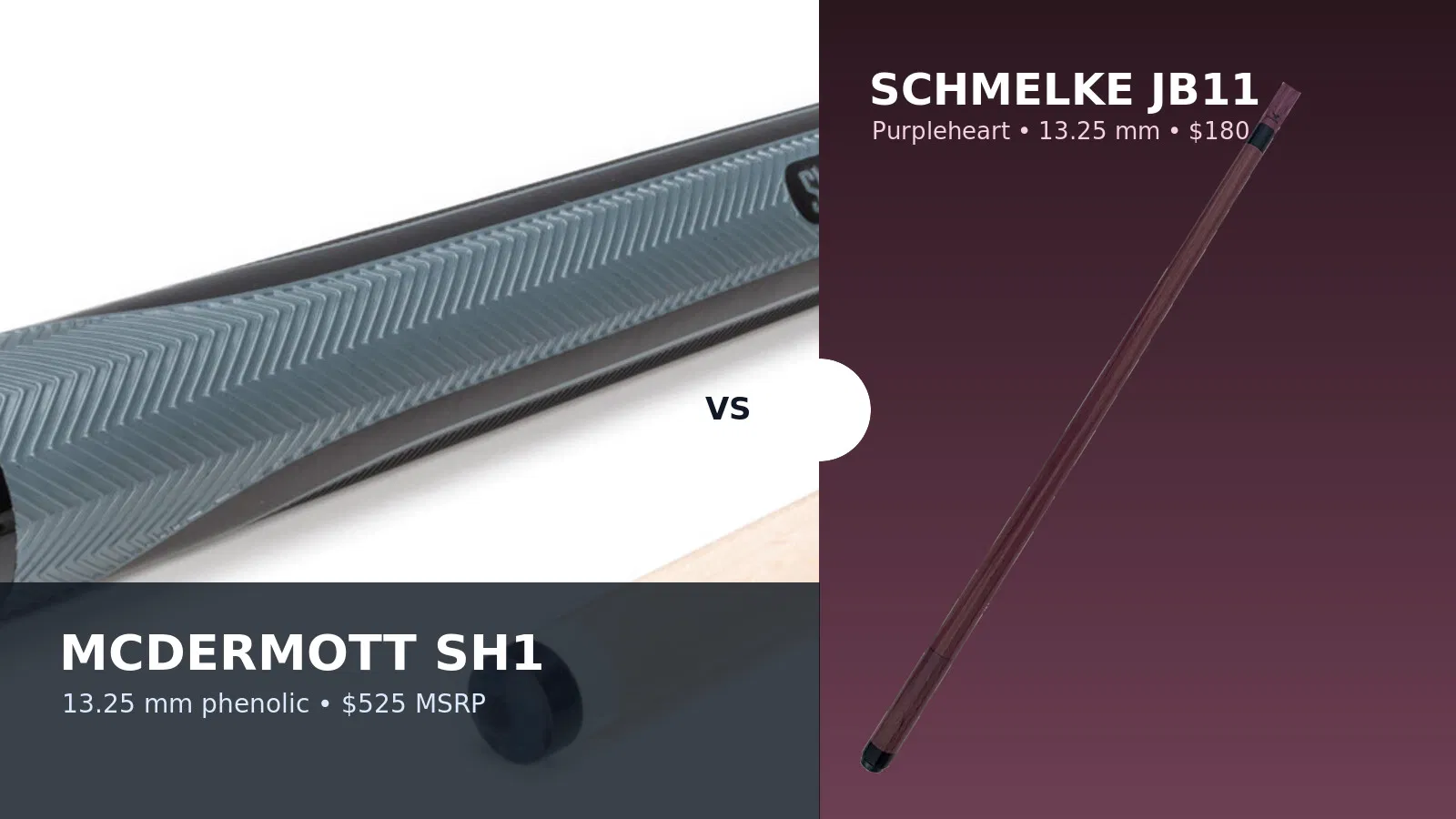
The Schmelke JB11 is the stronger value choice if you want a straightforward wood break cue with a 13.25 mm tip, selectable weight, and a current official price of $180. The McDermott Sledgehammer SH1 makes more sense for a buyer who specifically wants its phenolic tip-and-ferrule system, textured sport grip, and black hard-rock-maple build enough to accept a $525 MSRP.
The extra $345 does not come with published test data proving that the SH1 breaks harder or controls the cue ball better. It buys a different hardware package, grip design, finish, and brand-specific construction. That distinction should lead the purchase, not the assumption that a cue costing almost three times as much must deliver almost three times the result.
Why is this comparison closer than the prices suggest?
Both cues are dedicated to the break, use wooden shafts, list 13.25 mm at the tip, and carry a 3/8x10 joint description. Each also uses a break-specific taper rather than the long, forgiving profile expected from a playing shaft.
The overlap stops there. The Schmelke JB11 Purpleheart is built around a purpleheart butt and purpleheart shaft, a Kamikaze tip, a one-inch black Juma ferrule, no wrap, and four weight choices. The McDermott Sledgehammer SH1 uses hard rock maple, a phenolic tip, patented tip-and-ferrule technology, a strong taper through both butt and shaft, and a textured sport grip.
| Purchase question | Schmelke JB11 Purpleheart | McDermott Sledgehammer SH1 |
|---|---|---|
| Official price reference | $180 displayed price | $525 MSRP for complete cue |
| Price difference | Baseline | $345 more; 2.92 times the JB11 price |
| Intended role | Two-piece break cue | Dedicated break cue |
| Shaft wood | Purpleheart | Hard rock maple |
| Butt material | Purpleheart | Hard rock maple with black paint |
| Tip | Kamikaze, 13.25 mm | Phenolic, 13.25 mm |
| Ferrule | One-inch black Juma | Patented phenolic tip/ferrule system |
| Taper | Break taper | Strong taper; shaft described as short break/jump taper |
| Joint | 3/8x10, insert into wood thread | 3/8x10 standard |
| Grip | No wrap | Textured sport grip |
| Weight information | 19, 20, 21, or 22 oz | Not stated on the SH1 product page |
| Stock information | In stock on October 26, 2026 | No quantity or stock statement published |
This is therefore not a clean budget-versus-premium version of the same cue. It is a choice between two approaches to transmitting break energy and managing the rear hand.
What does the $180 Schmelke package include?
Schmelke publishes more configuration detail than the price might imply. The JB11 is a two-piece cue with purpleheart used for both the shaft and butt. Its shaft has a UV urethane finish, which the company says helps protect against moisture and chalk staining while reducing maintenance.

The JB11 uses purpleheart for both major sections and omits a wrap. Image: Schmelke.
The standard component list includes a 13.25 mm Kamikaze tip, one-inch black Juma ferrule, break taper, rubber bumper, and 3/8x10 joint. Buyers can choose 19, 20, 21, or 22 ounces, an unusually broad published range for a cue at this price.
The product sits inside Schmelke's “Jump Break Cues” category, but the page only describes a two-piece break cue. It does not state that the butt separates into a shorter jumping configuration. Until the manufacturer documents that function, the safe description is break cue, not convertible jump-break cue.
What is McDermott charging $525 for?
McDermott's complete SH1 carries an official $525 MSRP. A separate $190 figure on the same page refers to the Sledgehammer replacement shaft alone. Confusing those two numbers would turn this into a false $180-versus-$190 comparison.

The SH1 combines a black-painted hard-rock-maple butt, textured grip, and maple break shaft. Image: McDermott.
The defining SH1 feature is its 13.25 mm phenolic tip paired with McDermott's patented ferrule system. The company says the design transfers impact efficiently. That is a manufacturer claim about the construction, not an independent measurement of ball speed, rack spread, or cue-ball control.
McDermott also specifies a strong taper through the butt and shaft. Its shaft comparison page labels the Sledgehammer profile as a short break/jump taper and lists the standard joint as 3/8x10. The complete cue adds a textured sport grip that has no direct equivalent on the wrapless JB11.
Does phenolic automatically beat Juma and Kamikaze?
No. The two systems emphasize different component choices, but the official pages do not provide comparable impact testing.
The SH1 uses a phenolic tip and a phenolic ferrule system. Phenolic is hard and commonly selected for break equipment because it resists compression and can create a firm contact sensation. McDermott designed the SH1 around that pairing rather than treating the tip as an isolated part.
The JB11 uses a Kamikaze tip in front of a one-inch black Juma ferrule. Schmelke does not publish the tip material or a hardness grade on the product page. It says the setup is intended to balance control and power, but that statement cannot be converted into a numerical advantage.
A hard tip can change sound, feedback, and contact behavior. It cannot correct poor rack reading, off-center contact, or inconsistent speed. The better system is the one a player can strike accurately while staying within the equipment rules used by the room, league, or tournament.
Which grip is likely to suit your break stroke?
The JB11 is wrapless. The rear hand contacts finished purpleheart with no linen, leather, or rubber layer. Players who like a clean wooden handle and prefer to reposition the hand without catching a textured surface may find that layout appealing.
The SH1 uses a textured sport grip. Its molded pattern is designed to give the rear hand a more defined contact surface during an aggressive stroke.

McDermott's textured sport grip is one of the clearest functional differences from the wrapless JB11. Image: McDermott.
Grip preference is personal. More texture can feel secure to one player and restrictive to another. The product photos and material descriptions support a construction comparison, but they do not replace holding both cues under the same conditions.
Is adjustable weight the JB11's hidden advantage?
It is one of the JB11's strongest buying points because Schmelke states the options directly: 19, 20, 21, or 22 ounces.
That range lets a buyer match an existing break-cue preference without guessing. A heavier cue may encourage a smoother tempo for some players, while a lighter build may be easier to accelerate for others. Neither outcome is universal, and weight alone does not determine break speed.
McDermott does not publish the SH1's total weight or selectable weight range on the product page. Dealers may carry different configurations, but dealer listings should not be used to invent an official baseline. A buyer considering the SH1 should request the actual assembled weight before ordering.
At $525, an unanswered weight question matters. At $180, the JB11's four clearly listed options reduce order uncertainty and make it easier to repeat a familiar setup.
Can the two 3/8x10 shafts be swapped?
Do not assume so.
Both manufacturers use the label 3/8x10, but that only describes part of the connection. Collar diameter, joint face, pilot geometry, thread tolerances, insert design, and cosmetic alignment can still differ. Schmelke specifically describes its joint as an insert into wood thread, while McDermott identifies 3/8x10 as the SH1 standard.
McDermott recommends sending a cue to the company when purchasing a new shaft so the joint can be fitted and aligned. It also says fit and straightness cannot be guaranteed without that service. That guidance is enough reason to treat cross-brand compatibility as unverified.
The practical rule is simple: buy the cue for its complete factory configuration. If future shaft swapping is part of the plan, obtain written confirmation and have the assembled cue checked by the manufacturer or a qualified repair professional.
Is the SH1 worth paying 2.92 times as much?
It can be, but only for a narrower buyer.
The $345 premium is easier to justify when all three of these priorities are present:
- You specifically want a phenolic tip-and-ferrule break system.
- You prefer a textured grip over a finished wood handle.
- You value the Sledgehammer construction enough to accept an MSRP comparison rather than a proven performance gain.
If those priorities are absent, the JB11 makes a stronger paper case. It matches the 13.25 mm diameter and nominal joint format, publishes four weight choices, uses purpleheart throughout, and costs 65.7% less than the SH1 MSRP.
The SH1 may be available below MSRP through dealers, while JB11 pricing can also change. Compare actual delivered prices on the day of purchase, including shipping, tax, tip changes, and any fitting work.
Who should choose the Schmelke JB11?
The JB11 fits the buyer who wants:
- A dedicated wooden break cue at a low official price.
- Purpleheart in both shaft and butt.
- A wrapless handle.
- A clearly stated choice from 19 to 22 oz.
- A Juma ferrule and Kamikaze tip rather than phenolic hardware.
- A simple two-piece configuration with fewer unanswered specifications.
Its main limitation is not an obvious missing feature. It is the lack of independent break testing and the ambiguity created by the “Jump Break” category label. Buy it as the break cue the text actually describes.
Who should choose the McDermott SH1?
The SH1 fits the buyer who wants:
- McDermott's patented phenolic tip-and-ferrule system.
- A hard-rock-maple construction with a black finish.
- A strong break taper.
- A textured sport grip.
- The established Sledgehammer product design.
- A complete factory cue rather than adapting a standard player.
Its main limitation is value transparency. The official page does not publish total weight, length, current stock, or measured performance against cheaper break cues. The $525 figure is MSRP, so a buyer should verify the dealer's real price and exact configuration.
What is the final verdict?
The Schmelke JB11 wins the value comparison. At $180, it offers a documented purpleheart build, 13.25 mm tip, break taper, 3/8x10 joint, wrapless handle, and four weight choices. Its specifications make sense as a complete break-cue package without relying on a large brand premium.
The McDermott SH1 wins for a specific component preference, not for proven superiority. Its phenolic system, aggressive taper, and textured grip form a distinct design that some players will willingly pay for. Official data does not establish that it creates more break speed, better rack spread, or better cue-ball control than the JB11.
For most budget-aware buyers, start with the Schmelke. Choose the SH1 when you can name the exact Sledgehammer features you want and those features are worth $345 to you.
How much more does the McDermott SH1 cost than the Schmelke JB11?
Using the official figures checked on October 26, 2026, the $525 SH1 MSRP is $345 above the JB11's $180 displayed price. The SH1 costs about 2.92 times as much.
Is the McDermott Sledgehammer SH1 a $190 cue?
No. McDermott lists $525 MSRP for the complete SH1 cue. The $190 figure on the page applies to the replacement Sledgehammer shaft only.
Is the Schmelke JB11 a jump-break cue?
Schmelke places it in a Jump Break category, but the product text only confirms a two-piece break cue. It does not document a removable butt section or a separate jump configuration.
Do both break cues use a 13.25 mm tip?
Yes. Schmelke lists a 13.25 mm Kamikaze tip, while McDermott lists a 13.25 mm phenolic tip.
Will the JB11 shaft fit the SH1 because both use 3/8x10?
Compatibility is not verified. Matching thread labels do not guarantee the same collar, joint face, insert geometry, tolerances, or alignment. McDermott recommends factory fitting when adding a shaft.
More coverage
Keep reading
Viking eX101 vs Pure X HXTC14: The Better $351 Cue?
At nearly the same price, Viking’s eX101 and Pure X’s HXTC14 split on shaft detail, joint, grip and sale pricing. See which setup fits your game.
Richard Black Four Point vs Tascarella Standard Basic
Compare price transparency, construction, deposits and lead times before ordering a Richard Black Four Point or Tascarella Standard Basic cue.
Break Cue vs Playing Cue: Do You Need Both?
Break cues are built differently from playing cues — harder tips, stiffer shafts, different tapers. What the design changes, what it costs, and who actually needs one.