Meucci Hi-Pro 3 vs Pechauer DA1R: Which $1,000 Cue Fits?
The Meucci costs $50 less and arrives with a clearer standard spec. The Pechauer offers more joint choices, exposed Irish linen, and a shorter listed lead time.
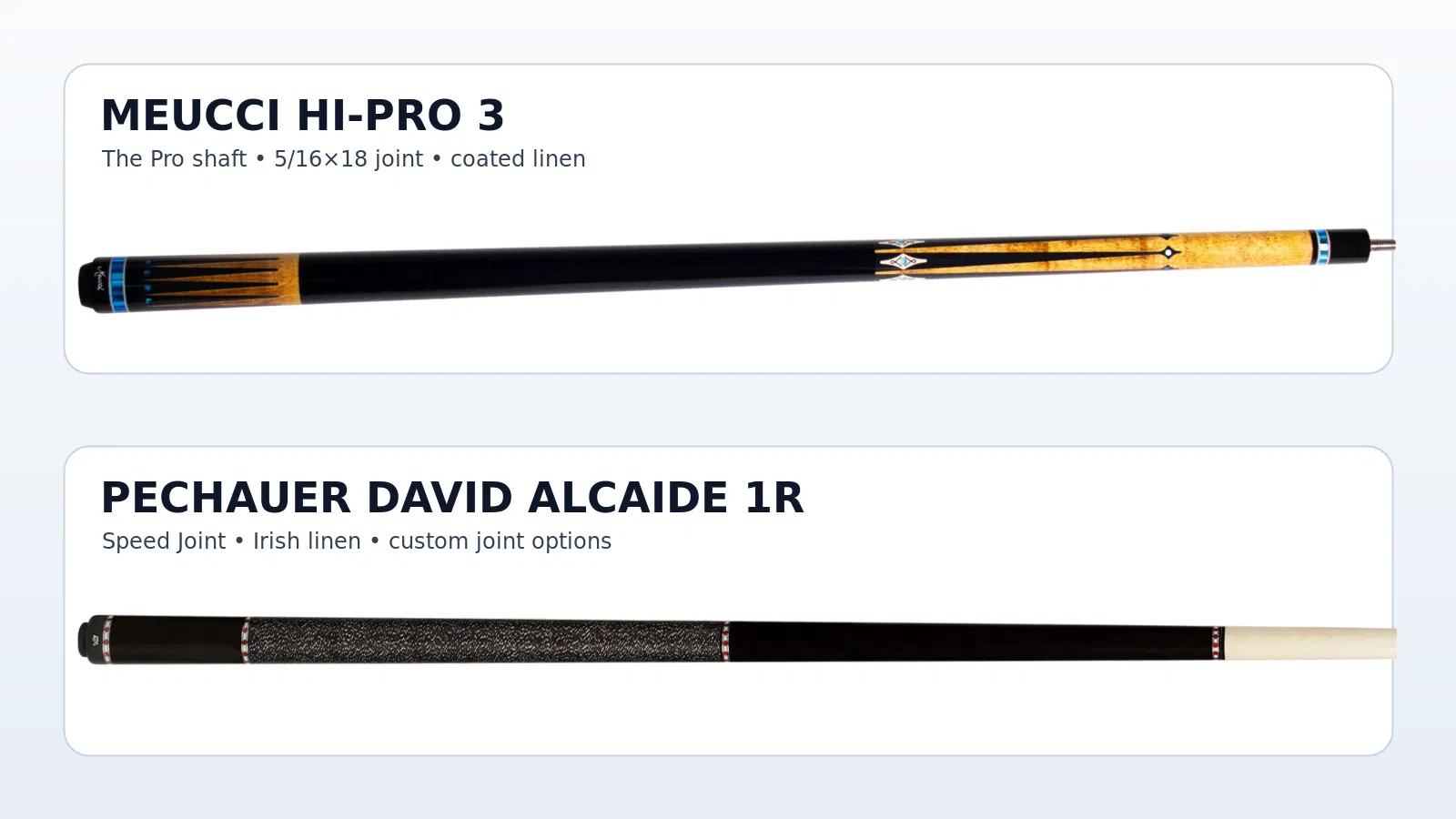
Buy the Meucci Hi-Pro 3 if you want the more clearly defined package: a 29-inch, 12.5 mm The Pro shaft, an adjustable 18–20 oz weight range, a 5/16x18 joint, and a $900 starting price. Choose the Pechauer David Alcaide 1R (DA1R) if exposed Irish linen, several joint choices, and a shorter listed wait matter more than saving $50.
That is the short answer as of October 23, 2026. The harder part is understanding what the extra $50 does and does not buy. These cues occupy the same price neighborhood, yet they solve the purchase decision in different ways. Meucci defines the standard configuration in detail. Pechauer turns the order page into a configurator.
Quick call: Hi-Pro 3 is the lower-risk online order when you accept its standard joint and shaft. DA1R is the more flexible order when you already know your preferred joint, wrap texture, and shaft setup.
What do the two base prices actually include?
The Meucci Hi-Pro 3 is listed at $900. Meucci identifies it as made to order and gives an estimated production time of 14–18 weeks. Its published standard package is unusually specific for a cue in this comparison: The Pro shaft, 29-inch shaft length, 12.5 mm tip diameter, Black Medium tip, 0.5-inch polycarbonate ferrule, and 5/16x18 pin.
The Pechauer David Alcaide 1R starts at $950. Pechauer currently states that the cue takes 4–8 weeks to ship. The standard joint is its piloted Speed Joint, while the order page also lists five paid joint alternatives. Pechauer publishes a Jade Medium tip, a 10–12-inch pro taper, a 5/8-inch ferrule, a black Juma joint collar, and a 0.850-inch joint size.
| Buying checkpoint | Meucci Hi-Pro 3 | Pechauer David Alcaide 1R |
|---|---|---|
| Base price | $900 | $950 |
| Listed lead time | 14–18 weeks production | 4–8 weeks to ship |
| Standard shaft | The Pro | Selected in configurator; default value is not stated in page text |
| Published tip diameter | 12.5 mm | Buyer-selectable; default is not stated in page text |
| Tip | Black Medium | Pechauer Jade Medium |
| Ferrule | 0.5-inch polycarbonate | 5/8 inch; material not stated on the DA1R page |
| Standard joint | 5/16x18 | Piloted Pechauer Speed Joint |
| Other joints | None listed on product page | 5/16x14, Radial, 3/8x10, Uni-Loc, 5/16x18 |
| Wrap | Linen under a clear coated surface | Exposed black-and-white Irish linen |
| Published weight | 19 oz standard, adjustable 18–20 oz | Chosen in configurator; default is not stated in page text |
| Main woods and decoration | Stained birdseye maple, dark points, cracked acrylic accents | Hand-selected ebony and maple, ruby sparkle diamonds |
The table reveals the real split. Meucci gives the buyer more certainty before checkout. Pechauer gives the buyer more choices during checkout.
Which cue makes the simpler online order?
The Hi-Pro 3 is easier to price and understand without a follow-up email. Its shaft length, diameter, tip, ferrule, pin, forearm material, wrap treatment, bumper, and weight system are all stated on one page. A buyer who likes those numbers can order with relatively few open questions.
The DA1R page exposes more controls, including shaft, tip diameter, shaft length, cue weight, butt length, joint style, and engraving. That flexibility is useful, but several selected defaults are not visible in the page text. The displayed $950 should therefore be treated as a starting price, not as a guaranteed price for every configuration.
Before paying for the Pechauer, save or request a written summary of the exact shaft, diameter, length, weight, joint, wrap, and final total. That small step prevents a buyer from assuming a menu default that was never confirmed.
How much does the wrap change the decision?
This may be the most important difference for players who keep a cue for years.
Meucci describes the Hi-Pro 3 wrap style as coated. Linen sits beneath a clear finished surface, so the hand contacts a smooth coating rather than exposed thread. The practical attraction is consistency: the surface is less dependent on the condition of the linen itself and will feel closer to a smooth wrapless handle than to a conventional linen wrap.

The Hi-Pro 3 uses stained birdseye maple and a linen wrap covered by a clear coat. Image: Meucci.
Pechauer specifies black-and-white Irish linen on the DA1R. Exposed linen gives the rear hand a distinct textile texture. Players who use that texture as a position reference may prefer it, while players who want the hand to slide over a sealed surface may favor the Meucci.

The DA1R pairs an ebony-and-maple design with exposed black-and-white Irish linen. Image: Pechauer.
Those are construction-based expectations, not the result of a side-by-side play test. Hand moisture, grip pressure, maintenance, and personal technique can reverse a preference that looks obvious on paper.
Does the Meucci shaft give it a technical advantage?
It gives the Meucci a documentation advantage, which is not the same as proving that it plays better.
Meucci supplies The Pro shaft at 29 inches and 12.5 mm, with a Black Medium tip and 0.5-inch polycarbonate ferrule. A buyer can compare those dimensions with an existing cue before ordering. The published 18–20 oz Everlock range also lets the owner adjust weight around the 19 oz standard setting.
Pechauer publishes the DA1R's standard tip, taper, and ferrule length, but the page asks the buyer to choose shaft and diameter in its configurator. The text available on the product page does not identify a single default shaft or tip diameter. That prevents a fair claim that the base DA1R is lower deflection, stiffer, softer, thinner, or thicker than the Hi-Pro 3.
If shaft behavior drives the purchase, compare the final Pechauer selection with The Pro shaft, not the DA1R butt by itself. The cue name and decorative collection do not determine the shaft's hit characteristics.
Which joint system offers more freedom?
Pechauer wins on factory-listed joint choice. The DA1R starts with a piloted Pechauer Speed Joint, then lists these alternatives:
- 5/16x14 full thread, piloted: +$25
- Radial: +$50
- 3/8x10: +$25
- Uni-Loc: +$75
- 5/16x18: +$25
That makes the cue $975 with 5/16x14, 3/8x10, or 5/16x18; $1,000 with Radial; and $1,025 with Uni-Loc, before any other paid option. The calculations simply add the displayed surcharge to the $950 base price.
Meucci lists a 5/16x18 pin for the Hi-Pro 3 and does not present other joint choices on that product page. For a buyer who already wants 5/16x18, the Meucci is $75 below a DA1R ordered with the same nominal thread label.
The label alone does not guarantee cross-brand shaft compatibility. Pilot geometry, collar diameter, joint face, thread fit, and cosmetic alignment still matter. Do not buy either cue on the assumption that every shaft carrying the same thread description will mate perfectly.
Is the shorter Pechauer wait worth $50?
For a deadline-driven buyer, it can be.
Meucci estimates 14–18 weeks of production. Pechauer currently says 4–8 weeks to ship. At the shortest ends, the difference is ten weeks; at the longest ends, it is also ten weeks. The wording is not identical, and neither range is a guaranteed delivery date, but the published gap is large enough to affect a tournament, birthday, or travel deadline.
The value equation changes if timing is irrelevant. Waiting longer for the Hi-Pro 3 saves $50 at the base level and gives the buyer a completely stated standard shaft and weight range. Paying more for the DA1R makes sense when its shorter listed schedule or configuration choices solve a specific need.
Lead times can change faster than cue specifications. Recheck the product page immediately before ordering and ask whether the estimate starts at payment, design approval, or final confirmation.
What design are you paying for?
The Hi-Pro 3 leans on contrast. Its stained birdseye-maple forearm carries four dark points with white and blue cracked-acrylic diamond accents. Matching shapes and acrylic bands continue through the sleeve. Meucci lists blue, red, and green color versions.
The DA1R belongs to Pechauer's David Alcaide Champion Collection. The page describes hand-selected ebony and maple with ruby sparkle diamonds. Its black-and-white linen and black Juma collar keep the palette darker and more restrained from a distance, while the ruby details appear in closer views.
Neither visual treatment improves accuracy by itself. Appearance matters here because both cues are made-to-order purchases near $1,000 and may stay in a player's case for many seasons. Choose the design you will still enjoy after the first-week excitement fades.
Who should buy the Meucci Hi-Pro 3?
Choose the Hi-Pro 3 when most of these statements fit:
- You already like a 12.5 mm tip diameter and 29-inch shaft.
- You want 5/16x18 without paying an added joint fee.
- You prefer a smooth, coated grip surface.
- You want a published 18–20 oz adjustment range.
- You value a clearly stated standard configuration over a long option list.
- You can accept the 14–18-week estimated production window.
The Hi-Pro 3 is the stronger value on paper for a buyer who would order it exactly as listed. Its lower price is only part of the case; the reduced configuration uncertainty is equally useful.
Who should buy the Pechauer DA1R?
Choose the DA1R when most of these statements fit:
- You prefer the texture of exposed Irish linen.
- You want the ebony, maple, and ruby-sparkle design.
- You need a factory-listed Radial, 3/8x10, Uni-Loc, 5/16x14, or 5/16x18 option.
- The current 4–8-week shipping estimate matters to your schedule.
- You are comfortable confirming every selected field before purchase.
- You would pay more for the right joint and shaft combination.
The DA1R earns its premium through choice and timing, not through a verified claim that it shoots better. Its advantage is strongest for buyers who will actively use the configurator rather than accept whatever happens to be preselected.
Which cue wins this comparison?
The Meucci Hi-Pro 3 is the better default buy at current prices. It costs $50 less, states its core shaft dimensions, includes 5/16x18, publishes an adjustable weight range, and leaves fewer unanswered questions for a remote buyer.
The Pechauer David Alcaide 1R is the better custom-order platform. It offers exposed Irish linen, more factory-listed joint choices, and a much shorter current lead-time range. Its final value depends on the selected shaft and paid options, so the checkout summary matters more than the headline price.
There is no evidence here that one cue produces better results on the table. The defensible decision rests on grip surface, joint preference, final shaft configuration, price after options, and how long you are willing to wait.
How much cheaper is the Meucci Hi-Pro 3 than the Pechauer DA1R?
At the displayed base prices, the $900 Meucci is $50 cheaper than the $950 Pechauer. The gap grows to $75 if the DA1R is ordered with the optional 5/16x18 joint.
Does the Hi-Pro 3 use exposed Irish linen?
No. Meucci lists a coated wrap, meaning the linen is covered by a smooth clear finish. The Pechauer DA1R uses exposed black-and-white Irish linen.
What shaft comes standard on the Meucci Hi-Pro 3?
Meucci lists The Pro shaft at 29 inches with a 12.5 mm tip diameter, Black Medium tip, and 0.5-inch polycarbonate ferrule.
Can the Pechauer DA1R be ordered with a 5/16x18 joint?
Yes. Pechauer lists 5/16x18 as a $25 option. That brings the cue to $975 before any other paid upgrades.
Which cue currently has the shorter listed wait?
Pechauer currently lists 4–8 weeks to ship for the DA1R. Meucci lists 14–18 weeks of estimated production for the Hi-Pro 3. Both are estimates and should be reconfirmed before purchase.
More coverage
Keep reading
Predator P3 Teal vs Cuetec SVB Gen II: Is REVO Worth It?
Predator P3 Teal with REVO meets Cuetec SVB Gen II with Cynergy. Compare total cost, taper, joint, weight tuning, and fit before buying.
Jacoby GC Turquoise vs Becue Natural Born Naked
Compare Jacoby GC Turquoise and Becue Natural Born Naked on shaft taper, joint, fit options, price clarity, and the buyer each cue suits best.
John Parris Supreme vs Peradon Century: Does Hand Splicing Win?
John Parris Supreme offers hand splicing and deep customization. Peradon Century uses machine splicing, lighter weights and faster extension joints.