Predator Air Rush vs Cuetec Propel: What Does $30 Buy?
The price gap is tiny. The real split is documented configurability versus a lighter all-composite design.
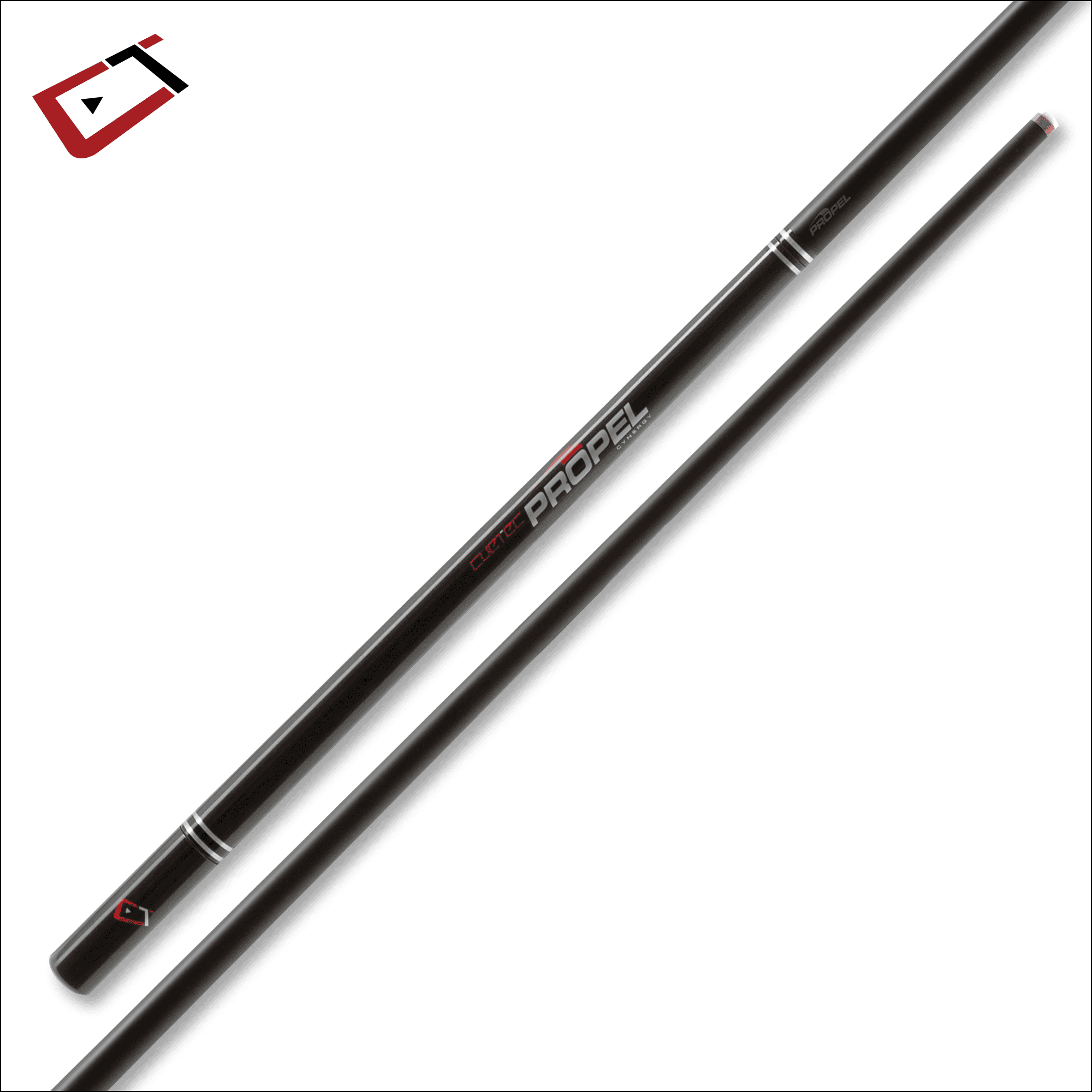
The Cuetec Cynergy Propel Galaxy Gray is the better value for most buyers at its $569 MSRP. It is $30 cheaper than the $599 Predator Air Rush Black, weighs 11 ounces with its extension attached, and has a clearly documented carbon-composite shaft, main handle, and Kintrol jump tip. The Air Rush earns the extra money only if you will use its two published length-and-weight configurations or strongly prefer Predator's quick-release assembly.
That $30 gap looks important on a product page. It isn't. The real decision is between Cuetec's lighter all-composite concept and Predator's better-documented conversion range.
Why is the $30 price gap not the main issue?
Both cues sit deep in the premium jump-cue category. The Predator Air Rush Black No Wrap is currently listed at $599 and marked in stock. The Cuetec Cynergy Propel Galaxy Gray carries a $569 MSRP, with Cuetec directing buyers to its dealer network.
Thirty dollars is about 5.3% of the Propel's price. That is too small a saving to justify choosing the wrong balance, assembly, or handle length. A jump cue is a specialized tool, and its short and long modes matter more than a modest discount.
There is no independent, controlled test showing that either retail cue jumps higher, lands the cue ball more accurately, or produces less unwanted spin across every shot. The useful comparison has to stay with the dimensions, weights, joints, and materials each company actually publishes.
How do the official specifications compare?
| Specification | Predator Air Rush Black | Cuetec Cynergy Propel Galaxy Gray |
|---|---|---|
| Current official price | $599 | $569 MSRP |
| Product code | CP PRE AIR RUSH NW GRP | 95-141B |
| Shaft | Air REVO carbon composite | Cynergy Propel carbon fiber composite |
| Shaft length | 29 inches | 29 inches |
| Tip diameter | 14 mm | 13.9 mm |
| Published tip description | Victory Medium; page also says phenolic material | Kintrol composite break/jump tip |
| Shaft collar or ferrule data | Not stated in the current specification table | Phenolic shaft collar |
| Joint | Uni-Loc Steel-Lite Quick Release | 3/8x14 Cuetec Modified, 21.30 mm |
| Two-piece configuration | 40.25 inches, 8.1 oz | Complete length and weight not stated |
| Full configuration | 51.5 inches, 12.1 oz | 11 oz with weighted extension attached |
| Main handle | Material not identified in current table | Carbon fiber composite, gloss finish |
| Extension | Three-piece system | Weighted extension, 3.46 inches |
| Wrap | No wrap | Gloss composite handle |
| Availability signal | Listed in stock | Dealer locator; no live stock count |
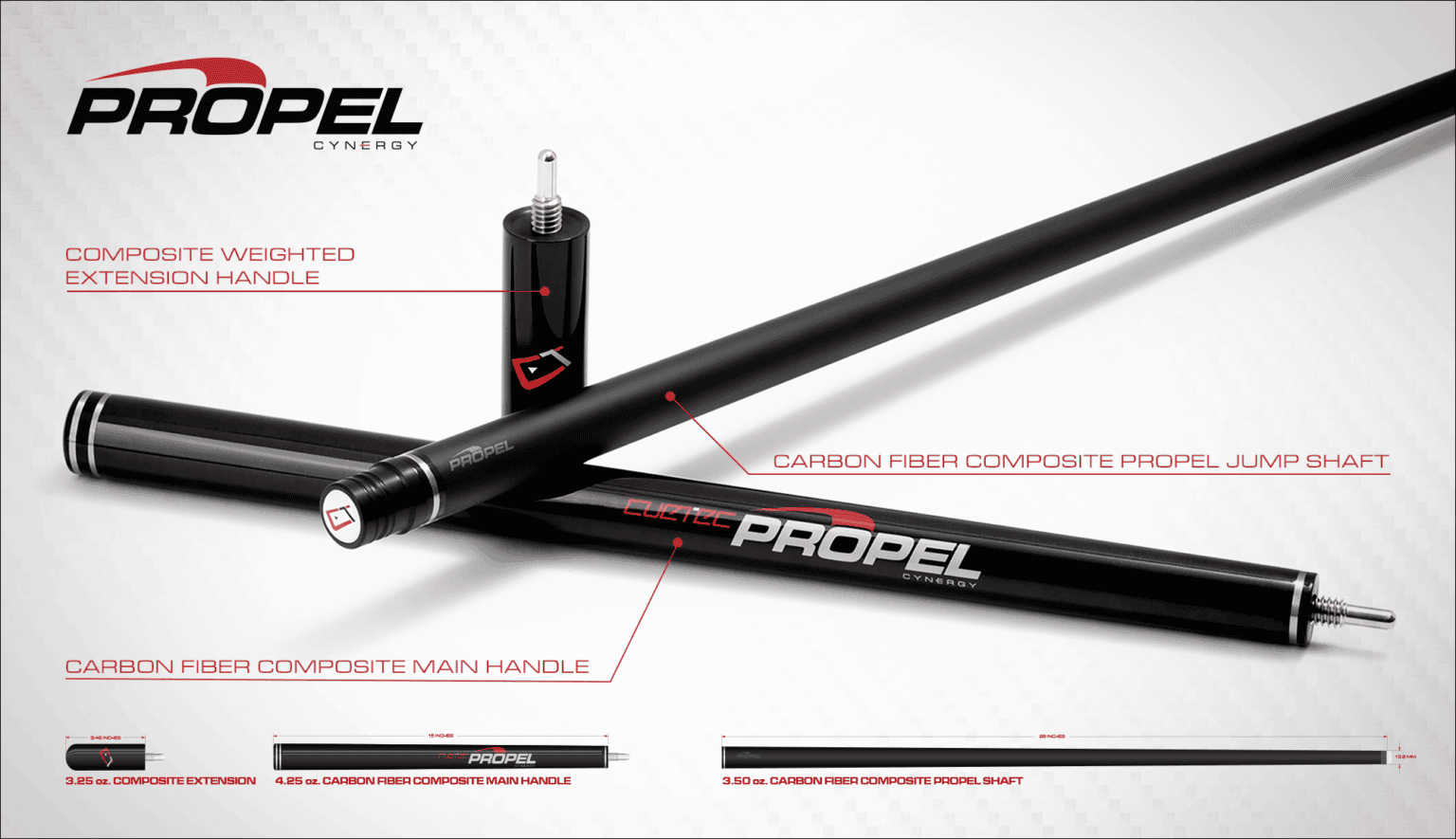
One caution matters here: Cuetec publishes component lengths of 29 inches for the shaft, 15 inches for the main handle, and 3.46 inches for the extension. It does not publish assembled lengths for the short and extended cue. Adding those numbers as if every joint had zero overlap would create a figure Cuetec hasn't confirmed.

What does the Air Rush give you for the extra $30?
Predator gives the cleaner answer to a practical question: what changes when the cue is reconfigured?
In two-piece form, the Air Rush measures 40.25 inches and weighs 8.1 ounces. With all three pieces assembled, it reaches 51.5 inches and 12.1 ounces. The conversion adds 11.25 inches and four ounces.
That is a meaningful swing. The short setup is aimed at steep, close-range jumps where a long butt can crowd the player's stance. The full setup supplies more cue behind the bridge for longer jump shots and a more conventional stroke. Predator doesn't leave the buyer to estimate either result.
The Uni-Loc Steel-Lite Quick Release joints also suit a cue that may be assembled differently several times during a match. Fast threads aren't a performance guarantee, but they reduce the fuss of changing modes under time pressure.
Air Rush buyers also get a 29-inch, 4.1-ounce Air REVO shaft. Predator lists the shaft, two-piece assembly, and three-piece assembly in one weight table, which makes pre-purchase comparison unusually straightforward.

What does the Propel do better on paper?
Cuetec is clearer about construction. Its official page identifies a Cynergy carbon fiber composite shaft and a carbon fiber composite main handle. The company describes the cue as an all-composite build and lists an 11-ounce standard weight with the weighted extension attached.
That full published weight is 1.1 ounces below the Air Rush's 12.1-ounce three-piece weight. The numbers don't describe identical lengths, so this is not a perfect like-for-like contest. It does tell us that the extended Propel is the lighter of the two published full assemblies.
The Propel also has the cleaner tip specification. Cuetec names its Kintrol composite break/jump tip, a phenolic shaft collar, a 13.9 mm diameter, and a 3/8x14 Cuetec Modified joint with a 21.30 mm collar diameter.
There is a tradeoff. Cuetec gives component lengths but not the cue's assembled short and extended lengths. It also doesn't list the cue's weight without the extension. Buyers can understand the materials and full weight, but they cannot build the same two-mode chart that Predator provides.
Is the Air Rush tip specification a problem?
It is a documentation problem, not proof of a product defect.
Predator's current specification table identifies the cue tip as Predator Victory Pool Cue Tip - Medium while the next line identifies the tip material as phenolic. Those descriptions do not normally point to the same type of tip. A layered Victory Medium playing tip and a hard phenolic jump tip are materially different products.
The page may contain a mislabeled field, an inherited catalog value, or a combination that needs more explanation. The available official text does not resolve it. A buyer who cares about the exact factory tip should ask Predator or the selling dealer to confirm what is installed on the specific cue before ordering.
Cuetec has the advantage here because its Kintrol composite break/jump tip is named consistently in both the product description and specification section.
Does a 0.1 mm tip difference matter?
For most players, not enough to decide the purchase.
The Air Rush is 14 mm and the Propel is 13.9 mm. A tenth of a millimeter is difficult to treat as a meaningful performance gap without controlled testing. Both are deliberately large jump-cue diameters that present a broad sight picture over the cue ball.
Tip hardness, shaft stiffness, cue angle, bridge stability, and contact point are far more likely to shape the result than 0.1 mm by itself. Anyone comfortable with one of these diameters should adapt quickly to the other.
The choice becomes more personal around the tip system. Cuetec clearly specifies a Kintrol composite tip. Predator's page needs clarification. That difference in documentation is more important than the nominal diameter gap.
Are the published weights directly comparable?
Only partly.
Predator's full cue weighs 12.1 ounces at 51.5 inches. Cuetec's Propel weighs 11 ounces with its weighted extension attached, but Cuetec does not state the assembled length in that mode. Saying that the Propel is 1.1 ounces lighter is accurate. Saying that it is lighter at the same length is not supported.
The short-mode comparison is even less complete. Predator publishes 8.1 ounces for its two-piece cue. Cuetec does not publish a no-extension weight. That missing figure matters because a short jump cue is often chosen precisely for how little mass must be lifted into a steep stroke.
Weight preference is also technique-dependent. A lighter jump cue can feel quick and easy to lift. Extra mass may help another player keep the cue moving through the ball. Neither number replaces a sound dart or pendulum stroke.
Which joint system is more convenient?
Predator has the stronger convenience case. Its Steel-Lite Quick Release hardware is built around rapid assembly changes, and the Air Rush's published two- and three-piece modes make that purpose obvious.
Cuetec uses a 3/8x14 Modified joint. It is a proprietary Cuetec specification with a listed 21.30 mm diameter, not a generic promise of cross-brand compatibility. The Propel's parts are intended to function as one system.
Do not assume Air Rush and Propel shafts, handles, or extensions can be mixed because both cues have removable pieces. Their joint standards are different, and neither manufacturer confirms cross-compatibility. Replacement parts should be matched by exact model and joint specification.
Which cue is easier to evaluate before buying?
The answer splits in two.
Predator makes the operating modes easier to evaluate. It publishes finished length and weight for both assemblies, shows live stock status, and sells the cue directly from its current product page.
Cuetec makes the materials easier to evaluate. It identifies carbon composite in the shaft and main handle, names the Kintrol tip, gives the collar material and diameter, and states the full weight with the extension. The buyer still has to contact a dealer for live availability and ask for the assembled dimensions if those measurements matter.
This is the odd part of the comparison: the Air Rush tells you more about geometry, while the Propel tells you more about construction.
Who should choose the Predator Air Rush?
Choose the Air Rush if:
- You expect to use both a short 40.25-inch setup and a full 51.5-inch setup.
- You want confirmed weights of 8.1 and 12.1 ounces for those modes.
- Quick-release assembly is a priority during matches.
- You already use Predator equipment and prefer to stay within that parts system.
- Paying $30 more is acceptable for clearer configuration data.
Pause before buying if the exact factory tip material is important. The current official page should be clarified first.
Who should choose the Cuetec Cynergy Propel?
Choose the Propel if:
- You want the lower $569 MSRP.
- You prefer an 11-ounce extended jump cue.
- You value a carbon-composite shaft and main handle with a clearly named construction.
- You want Cuetec's Kintrol composite jump tip and 3/8x14 Modified joint system.
- You do not need published assembled lengths before ordering.
The Propel is the stronger spec-sheet value. Its weak point is not the hardware described by Cuetec; it is the missing short-mode weight and assembled-length data.
Is the Predator Air Rush worth $30 more?
Yes for frequent configuration changes; no for most value-focused buyers.
Predator's extra $30 buys better information about how the cue transforms. The 40.25-inch, 8.1-ounce short mode and 51.5-inch, 12.1-ounce full mode are defined clearly. Players who use both styles of jump shot can justify the premium without stretching.
Cuetec wins the broader value verdict. The Propel costs less, publishes a lighter 11-ounce extended weight, and confirms carbon composite in both the shaft and main handle. Its Kintrol tip specification is also more coherent than Predator's current tip listing.
No official evidence proves that one cue jumps more accurately in every player's hands. The Air Rush is the configuration specialist. The Propel is the lower-priced, lighter full-build option. Pick the distinction you will actually feel, not the logo or the 0.1 mm tip difference.
How much do the Predator Air Rush and Cuetec Propel cost?
The Predator Air Rush Black No Wrap is listed at $599. The Cuetec Cynergy Propel Galaxy Gray has a $569 MSRP, making it $30 cheaper.
Which jump cue is lighter?
Cuetec lists the Propel at 11 ounces with its weighted extension attached, while Predator lists the three-piece Air Rush at 12.1 ounces. The assembled lengths are not confirmed as equal.
What are the Air Rush's two configurations?
Predator lists a 40.25-inch, 8.1-ounce two-piece setup and a 51.5-inch, 12.1-ounce three-piece setup.
What tip comes on the Predator Air Rush?
Predator's current page is inconsistent: it names a Victory Medium tip but also lists phenolic as the tip material. Buyers should confirm the installed tip with Predator or the dealer.
Can Air Rush and Propel parts be interchanged?
There is no official confirmation that they can. Predator uses a Uni-Loc Steel-Lite Quick Release joint, while Cuetec uses a 3/8x14 Modified joint.
More coverage
Keep reading
Tiger IMPAKT vs Pechauer Rogue Break: Is $150 Extra Worth It?
Tiger IMPAKT offers a complete carbon break cue from $950. Pechauer's Rogue-equipped breaker costs $800 and provides broader joint choices.
Mezz EC9-W vs Lucasi LHC14: What Does the Extra $44 Buy?
Mezz EC9-W costs $685 and favors documented maple specs. Lucasi LHC14 costs $729, adding an 11.75 mm shaft, G5 grip and vibration damping.
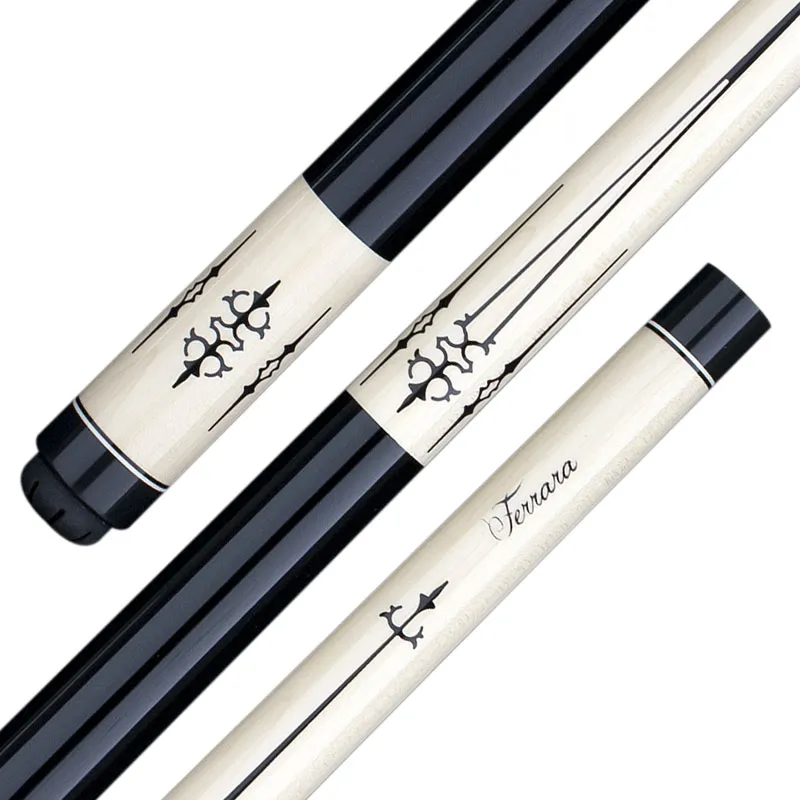
Predator CRM Sport vs Longoni Ferrara: Is Carbon Worth More?
Predator CRM Sport White adds REVO carbon, adjustable weight and quick release. Longoni Ferrara counters with maple, WJ22 and far lower dealer pricing.