Mezz EC9-W vs Lucasi LHC14: What Does the Extra $44 Buy?
One cue provides a detailed map of every key dimension. The other asks $44 more for a slimmer tip, sport grip and damping-focused design.
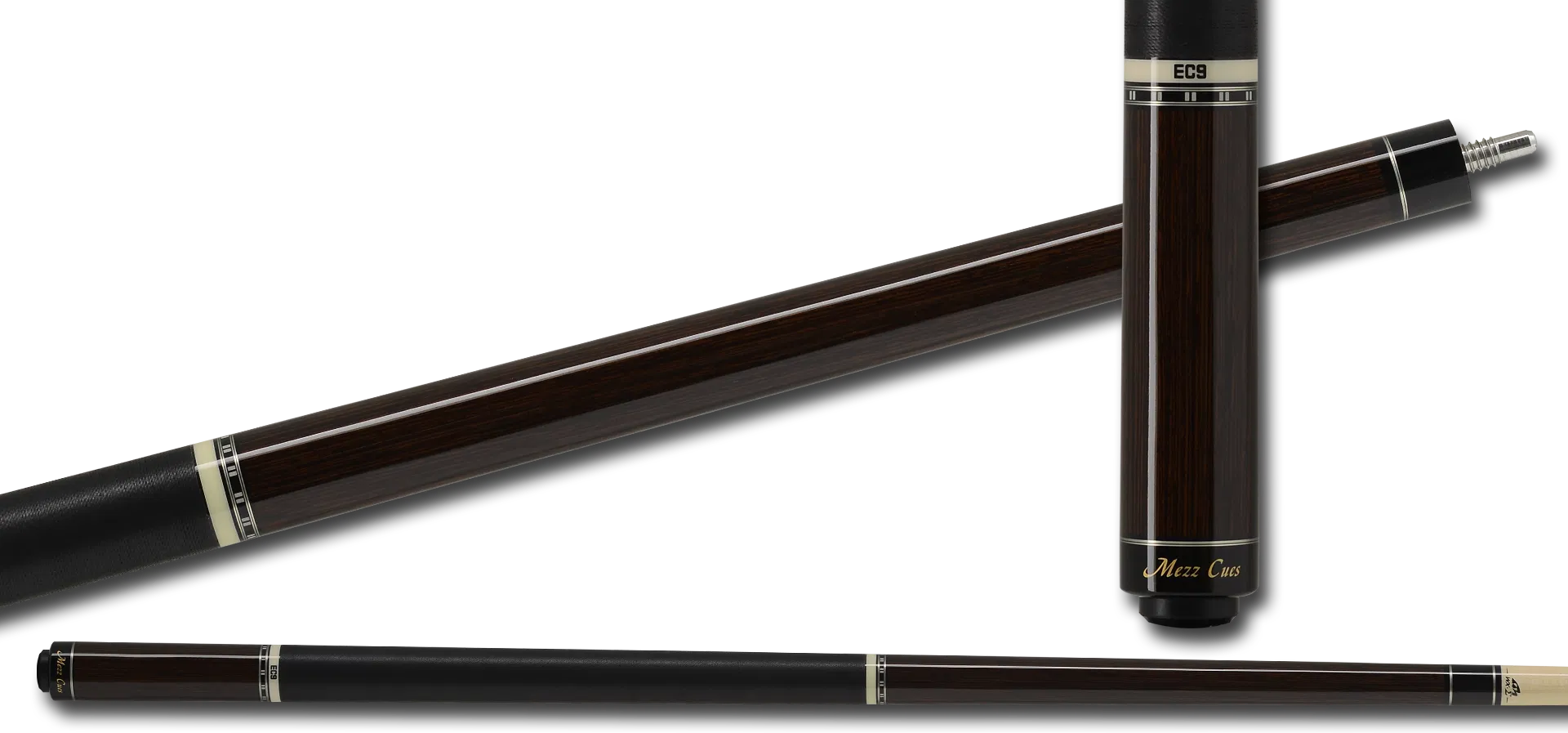
The Mezz EC9-W is the safer $685 choice for buyers who want every key dimension documented before they order. The $729 Lucasi Hybrid LHC14 makes a different case: its confirmed 11.75 mm tip, Fusion G5 sport grip, vibration-damping system, and quick-release joint create a more specialized package for only $44 more.
That does not make the Lucasi an automatic upgrade. The two cues solve different problems. Mezz gives the buyer a conventional linen-wrapped cue with a well-defined maple shaft. Lucasi puts more of the sales pitch into grip design and butt construction, while leaving several basic dimensions unpublished.
What are you really choosing at this price?
The price gap is small. Lucasi costs 6.4 percent more than Mezz, based on the current US listings checked on October 14, 2026.
The meaningful gap is not $44. It is the difference between a fully mapped configuration and a feature-led configuration.
Mezz states the EC9-W's shaft material, tip size, taper, shaft length, butt length, weight range, joint, grip, and woods. Lucasi confirms an 11.75 mm Zero Flexpoint Hybrid Slim shaft, Kamui Pro Soft tip, Uni-Loc quick-release joint, Fusion G5 Grip, X-Dampening, and four-piece butt construction. It does not state the cue's playing weight, shaft length, overall length, shaft material, ferrule, or taper on the current product page.
| Specification | Mezz EC9-W | Lucasi Hybrid LHC14 |
|---|---|---|
| Current US price | $685 | $729 |
| Price difference | Baseline | $44 more, or 6.4% |
| Listing status | Sold out at Mezz USA | Add-to-cart variant available |
| Standard shaft | WX-Sigma / United | Zero Flexpoint Hybrid Slim |
| Shaft construction | Hard maple | 10-piece radial TSC; material not stated |
| Tip diameter | 12.5 mm | 11.75 mm |
| Tip | Kamui Original Soft | Kamui Pro Soft |
| Taper | Pro Slim Taper | Not stated |
| Shaft length | 29 inches | Not stated |
| Butt length | 29 inches | Not stated |
| Nominal total length | 58 inches | Not stated |
| Weight | 19 to 19.5 oz | Not stated |
| Joint | Mezz United | Uni-Loc Quick-Release |
| Grip | Black Irish linen | Fusion G5 Grip |
| Damping feature | No comparable named system listed | X-Dampening Technology |
| Butt construction | Wenge forearm and butt sleeve | Four-piece construction |
One detail has become clearer since the initial comparison was prepared. The Lucasi product selector now exposes 11.75 mm as the current tip-size value. That number should replace the earlier “not verified” entry. The page still does not publish a complete taper description.
Why does the Mezz specification sheet matter?
Buying a cue online always involves some uncertainty. Mezz reduces it.
The official EC9-W page identifies a 29-inch WX-Sigma shaft and 29-inch butt, producing the familiar nominal 58-inch format. Weight is listed at 19 to 19.5 ounces. The grip is black Irish linen, and both the forearm and butt sleeve use wenge.
Its shaft details are equally specific. The WX-Sigma United page confirms hard maple, a 12.5 mm Kamui Original Soft tip, XJ Powerplate, and Pro Slim Taper.
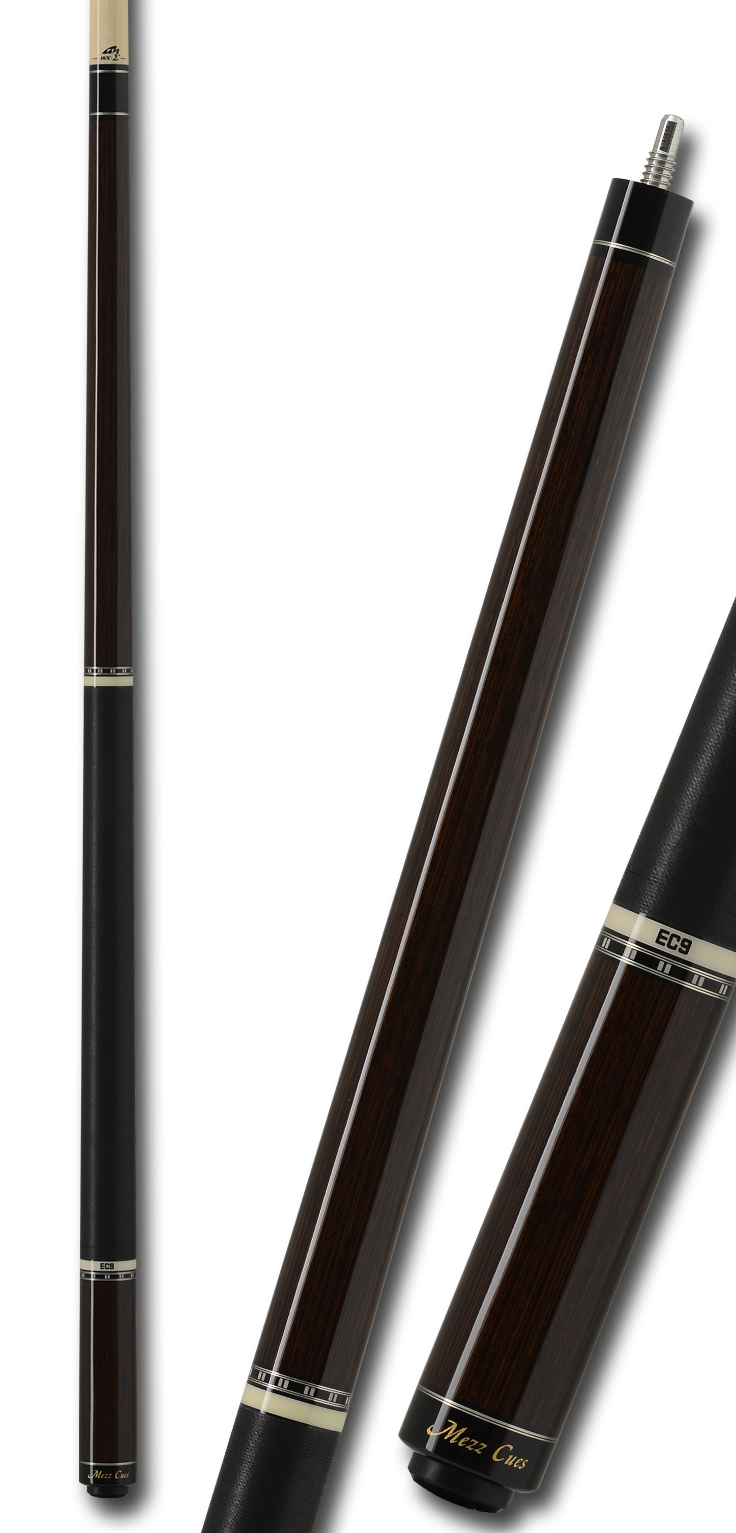
That clarity has practical value. A player who knows that 12.5 mm, soft tip, linen wrap, and a 19-ounce cue fit their preferences can buy with fewer unanswered questions. It also makes future shaft replacement easier to plan because the joint and original shaft dimensions are known.
The catch is immediate: Mezz USA lists the EC9-W at $685, but the purchase button currently reads “Sold Out.” The price is useful for comparison, not proof that a cue can be purchased from that store today.
What does the Lucasi add for $44?
Lucasi spends the price difference on features the player touches or notices during ownership.
The current LHC14 listing pairs a Zero Flexpoint Hybrid Slim shaft with a Fusion G5 Grip. The grip incorporates Lucasi's X-Dampening system, while the butt uses a four-piece construction. The joint is a quick-release Uni-Loc.

The tip end is also more compact. At 11.75 mm, it is 0.75 mm narrower than Mezz's 12.5 mm shaft. Players who prefer a smaller visual reference near the cue ball may favor that format. Tip diameter alone does not define stiffness, deflection, or accuracy, though. The undisclosed taper makes a full front-end comparison impossible from specifications alone.
The G5 grip is the clearest point of separation. It is a molded sport-style surface rather than linen. Someone who dislikes cloth wraps or wants more texture under the rear hand has a concrete reason to choose the Lucasi. Someone who adjusts the cue through the fingers and prefers a quieter, familiar linen surface may still favor Mezz.
Which shaft gives the stronger low-deflection case?
Both manufacturers position these shafts as low-deflection designs. Neither source provides a common measurement that lets a buyer rank them directly.
Mezz explains more of its front end. WX-Sigma uses hard maple, XJ Powerplate, a 12.5 mm tip, and Pro Slim Taper. Mezz says the redesigned front end reduces deflection while retaining a smooth and stable response.
Lucasi describes the Zero Flexpoint Hybrid Slim as a 10-piece radial TSC construction. The confirmed 11.75 mm tip makes it the smaller of the two, but the product page does not identify the complete taper, shaft length, ferrule, or exact material.
The smaller tip may allow more precise visual placement on the cue ball, but it does not prove lower squirt. Front-end mass, wall or laminate geometry, ferrule construction, taper, tip, and stroke speed all affect the result.
No controlled head-to-head test was found for these exact configurations. Any claim that one objectively deflects less would go beyond the available evidence.
Will the two soft tips feel the same?
No such assumption is safe.
Mezz fits a Kamui Original Soft. Lucasi lists a Kamui Pro Soft. Both carry a soft hardness label, but they are different named tip products mounted on different shaft structures.
The surrounding front end changes the response as much as the printed hardness category. Mezz combines its tip with an XJ Powerplate and a 12.5 mm maple shaft. Lucasi uses an 11.75 mm 10-piece radial design but does not publish the ferrule or taper details on this listing.
The useful conclusion is limited: both cues start with a soft Kamui tip. Sound, compression, feedback, and spin response cannot be ranked responsibly without matched table testing.
Does X-Dampening make Lucasi the smoother cue?
Lucasi markets X-Dampening as a way to reduce vibration through the Fusion G5 Grip. Its four-piece butt construction is also promoted as a route to a solid hit and improved durability.

Those are real design differences, but “less vibration” is not automatically “better feedback.” Some players want a damped sensation. Others use the vibration and sound of a traditional wood setup as part of their speed control.
Mezz does not advertise a comparable named damping system for the EC9-W. It uses wenge, a maple shaft, linen, and the United joint in a more conventional arrangement. That may be the attraction rather than a missing feature.
Without instrumented vibration data or a blind player panel, the honest distinction is preference: Lucasi deliberately filters the feel at the hand, while Mezz stays closer to a traditional wood-and-linen formula.
How much should the joint influence the decision?
More than the $44 difference.
Mezz United and Lucasi Uni-Loc Quick-Release belong to different shaft ecosystems. A buyer who already owns compatible shafts may save far more than $44 by staying with the matching platform.
The Uni-Loc mechanism emphasizes quick assembly. Mezz's United joint is part of the brand's established wood-shaft lineup and is used by the supplied WX-Sigma/U.
Do not buy on the word “quick-release” alone. Joint name, pin geometry, pilot, collar diameter, and joint face all matter. Cross-brand compatibility should be confirmed for the exact shaft and butt, even when a retailer uses a familiar joint label.
Which cue is easier to buy right now?
Lucasi wins the availability check.
The LHC14 page shows the Uni-Loc / 11.75 mm variant at $729 and allows it to be added to the cart. Stock can still change before checkout, but the listing currently presents a purchasable configuration.
Mezz USA shows $685 and “Sold Out.” Other authorized dealers may still hold inventory, yet the cited US distributor does not offer a direct purchase at the time of this check.
This changes the practical comparison. A $44 saving has little value if the Mezz cannot be sourced when the buyer needs it. A patient buyer can wait or search the dealer network. Someone replacing a damaged cue before a league or tournament date has a stronger reason to take the available Lucasi.
Who should choose the Mezz EC9-W?
Choose the EC9-W if the known configuration already matches your game:
- You want a 12.5 mm hard-maple low-deflection shaft.
- You prefer Irish linen over a molded sport grip.
- You want a stated Pro Slim Taper, 58-inch nominal length, and 19-to-19.5-ounce range.
- You already own United-joint equipment.
- You value a wenge cue with a restrained, traditional finish.
- You can wait for stock or locate one through another authorized seller.
The Mezz is the more transparent purchase. Its main weakness today is not the specification. It is availability.
Who should choose the Lucasi LHC14?
Choose the LHC14 if its specific features are the reason for buying:
- You want the slimmer 11.75 mm tip size.
- You prefer a textured G5 sport grip.
- You want the X-Dampening concept and four-piece butt design.
- You prefer a Uni-Loc quick-release joint.
- You want a model that currently presents an available US variant.
- You are willing to confirm weight, length, taper, ferrule, and balance before ordering.
The Lucasi is not simply the more modern cue. It is the more specialized one. Its value depends on whether the grip and damping system fit the player, not on the extra $44 by itself.
What should a buyer confirm before paying?
The Mezz needs an availability check. The Lucasi needs a specification check.
| Question for the seller | Mezz EC9-W | Lucasi LHC14 |
|---|---|---|
| Is the exact cue physically in stock? | Essential | Still recommended |
| What is the finished weight? | Choose within 19 to 19.5 oz | Must be confirmed |
| What is the assembled length? | Nominally 58 inches | Must be confirmed |
| What is the tip diameter? | 12.5 mm | 11.75 mm |
| What taper is supplied? | Pro Slim Taper | Must be confirmed |
| What shaft material is used? | Hard maple | Must be confirmed |
| Is the photographed variant the one shipping? | Confirm natural wood variation | Confirm exact product variant |
| Will existing shafts fit correctly? | Verify United fit | Verify exact Uni-Loc fit |
This list matters more for Lucasi because several ownership-critical dimensions are missing from the public description. A dealer answer in writing can prevent an expensive return.
Is the Lucasi worth the extra $44?
Yes, if the 11.75 mm front end, G5 grip, damping system, and immediate availability are features you actively want. In that case, $44 is a modest premium.
No, if you mainly want a predictable maple low-deflection cue with linen and clearly published dimensions. The Mezz gives a stronger specification-to-price package, provided you can actually find one in stock.
The final split is clean. EC9-W wins on documentation, traditional materials, and listed price. LHC14 wins on current availability, smaller tip diameter, grip texture, and damping-focused construction. There is no verified performance test that turns either choice into a universal winner.
What is the current price difference between the two cues?
Mezz USA lists the EC9-W at $685, while Cue & Case lists the Lucasi LHC14 at $729. The Lucasi costs $44 more, roughly 6.4 percent.
What tip size does the Lucasi LHC14 use?
The current product variant lists an 11.75 mm tip size. The Mezz EC9-W uses a 12.5 mm tip.
Is the Mezz EC9-W available from Mezz USA?
The page showed “Sold Out” during the October 14, 2026 check. Stock at other authorized dealers may differ.
Do both cues use maple shafts?
Mezz explicitly identifies the WX-Sigma as hard maple. The Lucasi page confirms a 10-piece radial TSC shaft construction but does not state the shaft material, so it should not be assumed.
Which cue is better for a buyer who dislikes vibration?
Lucasi is the more relevant candidate because it includes the Fusion G5 Grip with X-Dampening. No matched vibration test was found, so the size of the difference is unverified.
More coverage
Keep reading
Predator CRM Sport vs Longoni Ferrara: Is Carbon Worth More?
Predator CRM Sport White adds REVO carbon, adjustable weight and quick release. Longoni Ferrara counters with maple, WJ22 and far lower dealer pricing.
JFlowers DANTE 2 vs KONLLEN Nocturne-01: Where Does $100 Go?
JFlowers DANTE 2 costs $100 more than KONLLEN Nocturne-01. Compare carbon shafts, joint data, grip options, accessories and upgrade paths.
Mezz Airdrive 3 vs Rhino Voyager: Is $370 Extra Worth It?
Mezz Airdrive 3 costs $370 more than Rhino Voyager USA 2025. Compare length, tip, joint, carbon construction and value before choosing.