Mezz Airdrive 3 vs Rhino Voyager: Is $370 Extra Worth It?
One costs more than twice as much. The real question is whether Mezz's longer format and proprietary hardware improve the purchase enough to matter.
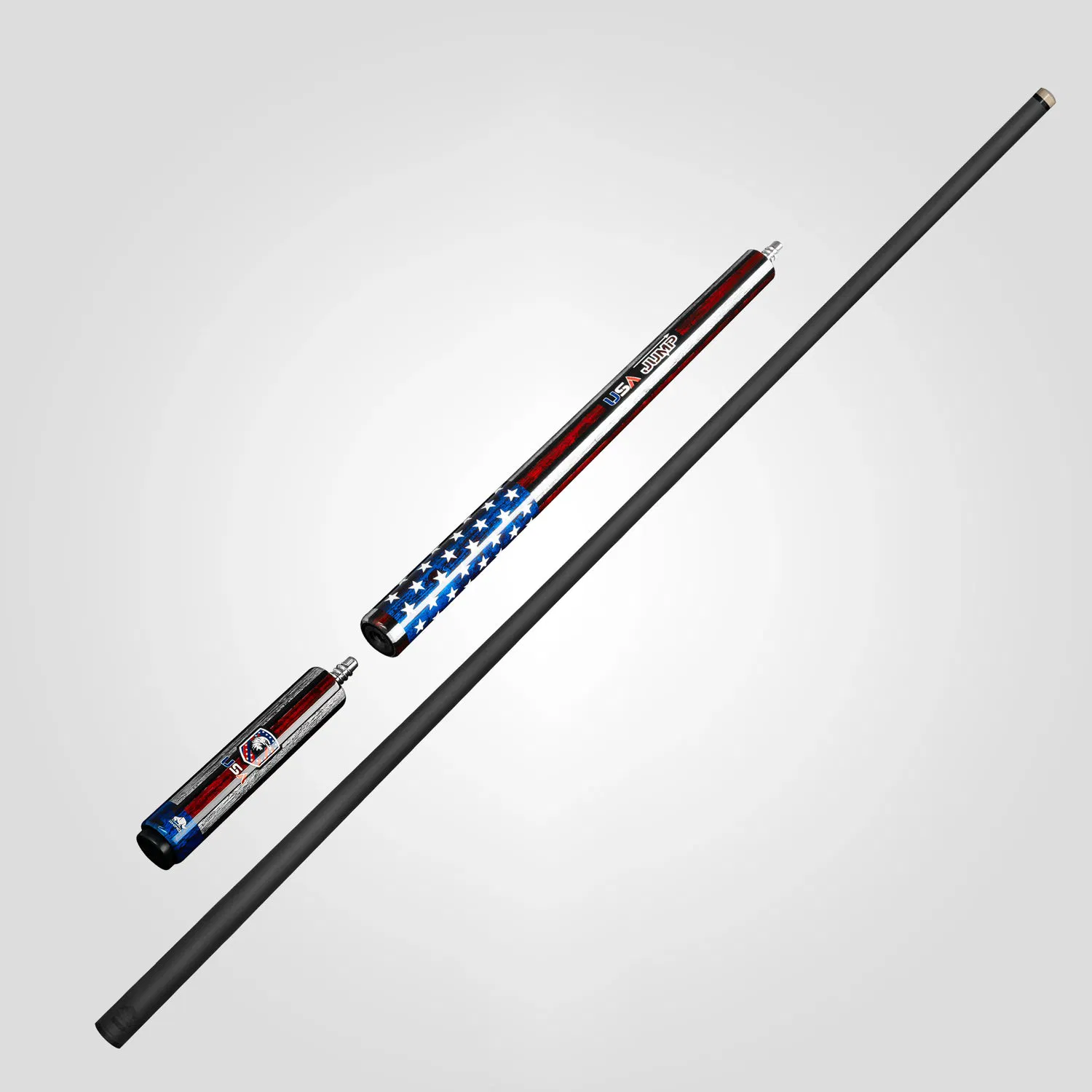
The Rhino Voyager USA Jump Cue 2025 makes the stronger value case at $359. The Mezz Airdrive 3 asks $729, and its extra $370 buys a more thoroughly documented, full-carbon system with a longer three-piece setup, published weights, a purpose-built front end, and Mezz's D2 quick-release joint. It does not buy proven double-the-performance. No controlled head-to-head test supports that claim.
That distinction matters. The Rhino costs 49.2% as much as the Mezz, yet both are dedicated three-piece jump cues with carbon-based construction and shafts close to 29 inches. A player choosing between them isn't deciding between a toy and a serious cue. The decision is between a lower-cost specialist with a few specification gaps and a premium specialist whose design is explained in much greater detail.
What does each $359 or $729 package include?
The table below uses current manufacturer listings checked on October 9, 2026. Mezz publishes a more complete set of measurements, while Rhino leaves several useful numbers unstated.
| Specification | Mezz Airdrive 3 | Rhino Voyager USA Jump Cue 2025 |
|---|---|---|
| Current listed price | $729 | $359 |
| Price difference | $370 more | Baseline |
| Construction | Full-carbon three-piece jump cue | Carbon shaft; carbon-and-glass-fiber composite butt |
| Shaft | AD3 carbon shaft | Premium carbon shaft |
| Shaft length | 29 inches | Approximately 29 inches |
| Tip | Tsubasa | Upgraded Bakelite |
| Tip diameter | 13.5 mm on Mezz's global site; 13.6 mm on Mezz USA | 13.9 mm |
| Front-end system | AD Powerplate | Not specified |
| Joint | D2 proprietary quick release | Mini 3/8-8 stainless steel |
| Two-piece length | 41.3 inches | Not officially stated |
| Three-piece length | 51.2 inches | Not officially stated |
| Published weight | 8.5 oz in two-piece form; 13 oz in three-piece form | Not stated |
| Joint protectors | Not stated on the cited product page | Included |
| Availability at check | Sold out on Mezz USA | In stock |
The 13.5 versus 13.6 mm discrepancy is small, but it is still a discrepancy. The global Mezz specification lists 13.5 mm, while Mezz USA lists 13.6 mm. Buyers who care about the exact diameter should confirm the regional stock before ordering.
Where does the extra $370 go?
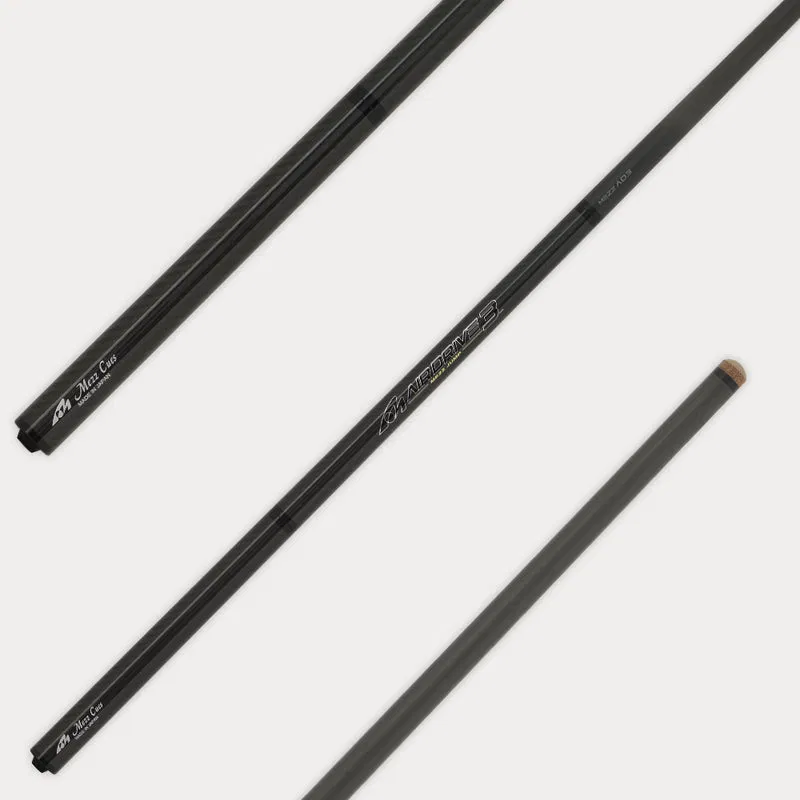
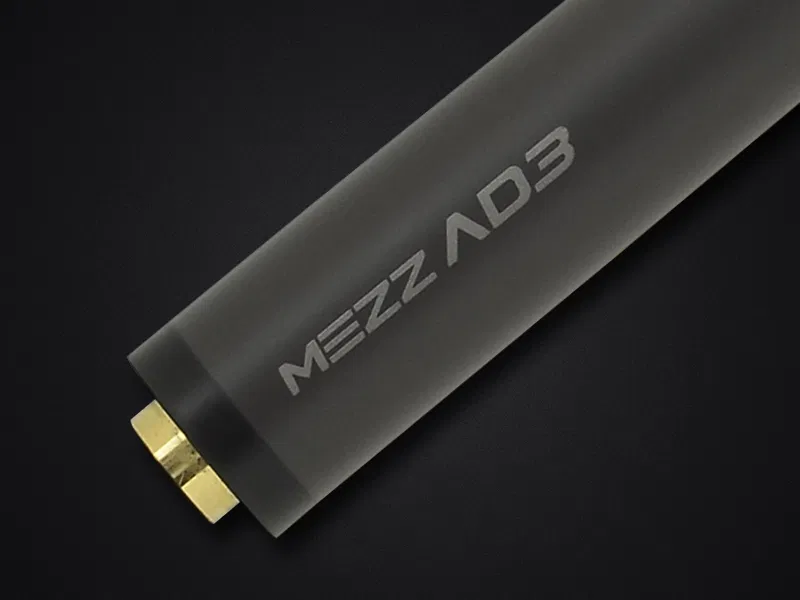
Most of the visible premium sits in system design rather than ornament. Mezz describes the Airdrive 3 as a full-carbon cue, not simply a cue fitted with a carbon shaft. Its AD3 shaft, Tsubasa tip, AD Powerplate, taper, and two D2 connection points are presented as parts of one jump-specific platform.
That integration has practical appeal. The published two-piece and three-piece weights tell a buyer exactly what will be in hand: 8.5 ounces for the shorter configuration and 13 ounces with the extension fitted. The matching published lengths make the setup easier to compare with a current jump cue or a case compartment before money changes hands.
Rhino takes a leaner route. Its official listing identifies a roughly 29-inch carbon shaft, a 13.9 mm Bakelite tip, a Mini 3/8-8 stainless joint, and two butt sections measuring about 13 inches and 5.12 inches. Rhino's FAQ clarifies that the butt is a carbon-and-glass-fiber composite. That is meaningful construction information, but the company doesn't publish total weight, balance point, taper, ferrule details, or assembled length.
Those omissions don't make the Voyager less capable. They make it harder to buy by spreadsheet. A player ordering the Rhino is accepting more uncertainty in exchange for keeping $370.
Do the two tips point to different playing styles?
Yes, at least in design intent. The Mezz uses a 13.5 or 13.6 mm Tsubasa tip paired with the AD Powerplate. Mezz says the front-end design is intended to transfer force efficiently and support control across different jump situations. The slightly smaller diameter may also look more familiar to players who dislike an oversized jump tip.
The Rhino's 13.9 mm Bakelite tip is wider and built around the hard, direct contact many players expect from a dedicated jumper. Bakelite is associated with a sharp transfer of energy and a compact stroke. It can be effective, but it is not automatically easier to control. Tip curvature, chalk condition, elevation, grip pressure, and stroke timing still do a great deal of the work.
The honest answer ends there. Manufacturer specifications can describe materials and geometry; they cannot establish which cue produces the cleaner jump in a player's hands. We found no independent test that uses the same shooter, ball positions, cloth, cue-ball condition, and successful-jump criteria for both models.
Does the longer three-piece Mezz offer a clear advantage?
Mezz publishes a 41.3-inch two-piece length and a 51.2-inch three-piece length. That longer form gives players a conventional stroke platform when the cue ball is farther from the blocker or when a controlled landing matters more than clearing a ball at point-blank range. Remove the rear section and the cue becomes shorter and lighter for steep elevation in cramped positions.
Rhino supplies about 29 inches of shaft plus butt pieces of roughly 13 inches and 5.12 inches. Adding the raw section figures produces about 47.12 inches in three-piece form and 42 inches in two-piece form. Those are arithmetic estimates, not verified assembled lengths. Joint overlap, measurement method, and hardware can change the final number, so they should not be treated as official dimensions.
This is one place where Mezz earns part of its premium before either cue reaches the table. Its measurements remove doubt. The Rhino may fit a player's preferred stance perfectly, but the official listing does not let us prove it in advance.
Which joint system is easier to live with?
Neither joint is a universal compatibility promise.
Mezz's D2 is a proprietary quick-release design used between the AD3 sections. Its appeal is speed and a system engineered around the cue's intended weight and length. The trade-off is dependence on Mezz-specific parts. A lost or damaged section isn't something a player should assume can be replaced by any shaft with a visually similar pin.
Rhino uses a Mini 3/8-8 stainless steel joint and includes joint protectors. The specification sounds more familiar, but “3/8-8” alone does not guarantee cross-brand fit. Pilot shape, thread tolerances, insert depth, and facing still matter. Buy the Voyager as a complete matched cue, not as a shortcut to mixing unverified sections from another maker.
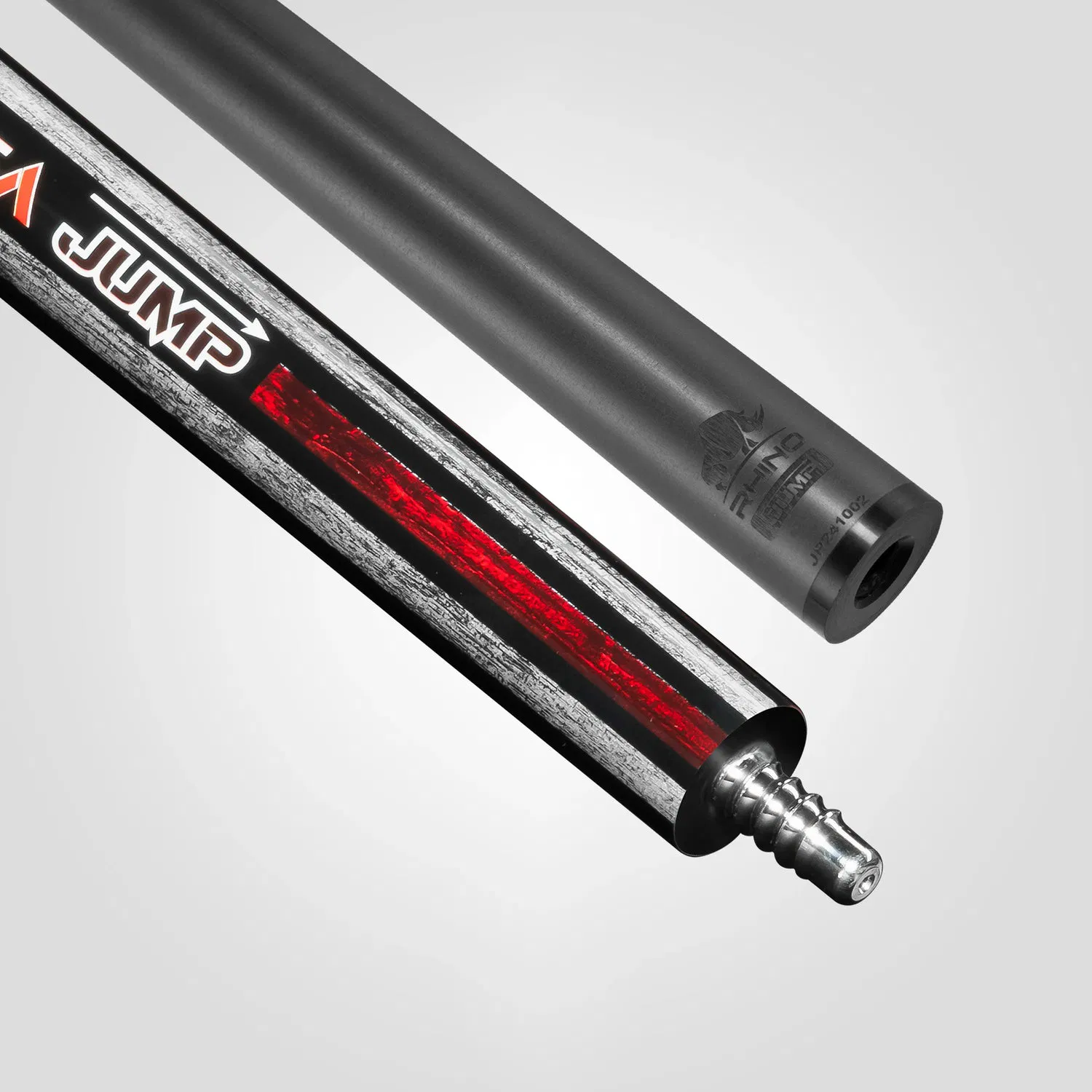
For travel, both three-piece formats are sensible. The cue breaks down into short components rather than demanding a full jump-cue sleeve. Rhino's included protectors are a useful small win because exposed threads and joint faces take abuse inside crowded cases.
Is professional use a reason to pay for the Mezz?
It is context, not proof. Mezz lists the Airdrive 3 in the equipment profiles of professional players Bryzen Ace Manipula and Timothei Furko. That confirms the cue is part of real tournament equipment choices. It does not tell us that the Airdrive 3 will add a specific success percentage to another player's jump shots, nor does it establish superiority over the Voyager.
Professional equipment choices are shaped by stroke, familiarity, sponsorship, maintenance support, and years of repetition. A name on an equipment page may reassure a buyer that the design belongs in serious competition. It should not replace fit, budget, or practice.
Who should buy the Rhino Voyager USA?
Choose the Rhino if the aim is to add a dedicated carbon-shaft jumper without turning the purchase into a $700 decision. At $359, it leaves room for lessons, table time, a better case, or several tournament entries. Those can improve actual results more reliably than assuming price alone will solve technique.
The Voyager also suits players who prefer a wider 13.9 mm hard tip and don't mind buying with a few unanswered specification questions. Its USA graphics are bold. Some players will love them; others will want something quieter. That is a taste decision, not a performance fault.
Stock status favors Rhino as well. It was marked in stock during our check, while the Airdrive 3 was sold out on Mezz USA. Availability can change, but a cue that can be purchased today has an obvious practical edge over one that requires a restock wait.
Who should pay more for the Mezz Airdrive 3?
Choose the Mezz if the known dimensions, modular lengths, published weights, and integrated front-end design are worth paying for. The premium makes the most sense for a committed player who already knows why 8.5 ounces in short form or 51.2 inches in full form fits a specific jumping technique.
The Airdrive 3 also makes sense for a player already comfortable with Mezz engineering and support. Made in Japan, it is presented as a complete system rather than a collection of broad material claims. Its black finish is restrained, and its specification sheet is unusually clear for this category.
Don't pay the extra $370 simply because the cue costs more or appears in professional equipment profiles. Pay it for the exact hardware, dimensions, weight targets, and ownership experience. If those details don't answer a problem you currently have, the premium is hard to defend.
Is the Mezz Airdrive 3 worth $370 more?
For most value-focused buyers, no. The Rhino Voyager USA supplies the core proposition of a modern three-piece jump cue for $359, less than half the Mezz price. It is the rational starting point if the goal is a dedicated jumper with a carbon shaft and a hard 13.9 mm tip.
For a narrower group, yes. The Mezz justifies its price through a full-carbon construction, clearly published lengths and weights, a coordinated tip-and-Powerplate front end, and D2 quick-release hardware. It is the more complete technical product on paper.
The key phrase is “on paper.” Without a controlled comparison, there is no factual basis for saying it jumps twice as well, jumps 103% better, or guarantees more successful escapes. The Mezz costs 103.1% more. Performance doesn't follow that arithmetic.
The sensible verdict is simple: buy the Rhino for value, buy the Mezz for specificity. The $370 premium is worthwhile only when its measurable differences match the way you already play.
How much more does the Mezz Airdrive 3 cost than the Rhino Voyager USA?
At the prices checked on October 9, 2026, the Mezz was $729 and the Rhino was $359. The difference is $370, so the Mezz costs about 103.1% more.
Are both cues made entirely from carbon fiber?
No. Mezz describes the Airdrive 3 as a full-carbon jump cue. Rhino uses a carbon shaft, while its FAQ describes the butt as a composite of carbon fiber and glass fiber.
What is the assembled length of the Rhino Voyager USA?
Rhino does not publish a confirmed assembled length. Adding its approximate section measurements gives about 42 inches in two-piece form and 47.12 inches in three-piece form, but those are estimates rather than official finished lengths.
Can Mezz and Rhino jump-cue sections be interchanged?
There is no official confirmation of cross-compatibility. Mezz uses its proprietary D2 joint, and Rhino uses a Mini 3/8-8 joint, so buyers should treat each cue as its own matched system.
Which cue is better for a first dedicated jump cue?
The Rhino is the lower-risk purchase because it costs $370 less and still provides a carbon shaft, hard Bakelite tip, three-piece format, and included joint protectors. The Mezz is better suited to buyers who can name the specific dimensions or design features they need.
More coverage
Keep reading
Rhino Retro II vs Valhalla VC06: Is Full Carbon Worth $104?
Rhino Retro II or Valhalla VC06? See whether a carbon butt, two shaft sizes and published 59-inch length justify the extra $104.
Viking SS-1026A vs Cuetec SVB Gen II: What Does $199 Buy?
Viking SS-1026A or Cuetec SVB Gen II? See what the extra $199 buys in shaft choice, weight control, extension support and flexibility.
McDermott G241C vs Pechauer P03-R: Tech or Custom Fit?
McDermott G241C and Pechauer P03-R sit $25 apart, but G-Core shaft technology and Pechauer customization create very different buying cases.